Please Hit

Folks, This is a Free Site and will ALWAYS stay that way. But the only way I offset my expenses is through the donations of my readers. PLEASE Consider Making a Donation to Keep This Site Going. SO HIT THE TIP JAR (it's on the left-hand column).

Sunday, July 8, 2007

Pat Sanity Wants To Take Over the World: Sunday Night Reading


Today's Email announcing the Carnival of the Insanities had a curious ending
As always, a link or trackback is appreciated and helpful in achieving my desire to utterly dominate the blogsphere! BWAHAHAHAHA.
So is Pat Sanity trying to take over the blogsphere? Well there is only one way to know for sure.... go read this week's carnival for clues...besides saving the blogsphere you might find some really great reading click here to help find out the evil doctor Sanity's plot http://drsanity.blogspot.com/2007/07/carnival-of-insanities_08.html

On a seperate note Happy Birthday
Tzipi Livni and Yidwithlid.

Below are some pretty good posts from the past week that you may have missed:

The Inherent Racism of PC and how it will get us ALL Killed

Hamas; See We're GOOD GUYS NOW

Homeland Insecurity


Israel and China: More than Just Sunday Night Dinner

I believe that this year is 4607 in the Chinese calender and 5757 in the Hebrew Calendar if my numbers are correct this means that for 1,150 years Jews had no where to eat on Sunday nights. Despite that old groaner, the connection between the Chinese and Jewish people goes way beyond running to Main Street on Sunday afternoon for kosher Chinese food. While many countries refused to take and protect Jews fleeing the Shaoh, China did.

Mr. Ho Fengshan, was the Chinese consul-general in Vienna, Austria from 1938 to 1940. He risked his life and career to issue hundreds of visas to Jewish refugees, which enabled them to go to Shanghai, China, to flee Nazis' rule over Austria. Yad Vashem has given Ho the title of Righteous Among the Nations from Yad Vashem for his brave efforts.

Almost seventy years later, Israel and China have become important trading partners as described in this week's Business Week;

The China-Israel Connection

Though at present it's only responsible for 1% of imports, the Jewish state's presence in Asia's No. 1 economic powerhouse is rapidly expanding

Eli Glazer moved with his family to Shanghai less than four months ago to take up a post there as general manager for Israel Chemicals, one of Israel's leading industrial concerns. In doing so, he became the latest member of a rapidly expanding Israeli business community in China's booming commercial capital.

The Israeli presence underscores the growing importance of trade relations between the two countries. Israel-China trade climbed nearly 30% in 2006, to $3.8 billion, and is expected to reach $5 billion this year, catapulting China to the position of Israel's No. 2 trading partner, second only to the U.S. During an official visit to China last week, Israeli Prime Minister Ehud Olmert said he expects a further doubling in trade, to $10 billion annually, by 2010.

But official statistics don't tell the whole story. The China trade figures exclude business with Hong Kong, even though much of it is redirected to the mainland. The numbers also would be higher if Israel's lucrative arms sales to China hadn't come to an abrupt end in 2005 under heavy pressure from the Bush administration.

Redistributing the Resources

Fortunately for Israel, the Chinese are interested in more than just military hardware. As with many countries, Israel has been flooded with imports of Chinese consumer goods and textiles in recent years. But moving in the other direction, hundreds of Israeli high-tech, chemical, and agricultural technology companies have seen exports to China soar.

"China is already a major market for us and accounts for hundreds of millions of dollars in annual sales," says Glazer of Israel Chemicals. The company is one of Israel's largest exporters to China, where it sells potash and industrial chemicals and has set up five joint venture factories.

China also is becoming a big buyer of Israeli agro-technology. Companies like Netafim, a world leader in drip irrigation systems, have seen steady growth in demand in the past decade. The company has even opened a factory in China. "With water shortages becoming more acute we expect China to become one of our major markets in the coming years" says Rami Levy, managing director of Netafim Asia Pacific.

Salt of the Earth

Indeed, water was a major topic of discussion during Olmert's Beijing visit, during which the two countries inked a water technology agreement. "For China, water is as important as oil," the Israeli prime minister said at the signing ceremony, noting that Israel is a world leader in desalination and recycling technologies.

Israeli companies are already drumming up deals. Just days before the water deal was signed, Israel's Global Environmental Services (GES) announced a $5 million water purification project in Inner Mongolia. The company also said it is in talks for a huge desalination project in another region of China.

Perhaps Israel's biggest export to China is high tech. Established companies like ECI Telecom (ECIL), a maker of telecommunications equipment, initially followed the joint venture route. The company, based in Petah Tikva, Israel, entered China eight years ago through a venture with Eastern Communications Company (Eastcom), a leading Chinese manufacturer of cellular technology.

First Stop for Some Tech

But in 2006 ECI took over full control of the joint venture, which produces components for ECI products and more recently has started doing research and development work for its Israeli parent company. "Now nearly 10% of our 3,000 employees are located in China," says ECI Chief Executive Rafi Maor.

Even high tech newcomers have discovered the potential of the Chinese market. "It used to be that our startups ran straight to the American market, but now we're seeing many go first to China," says Yoram Oron, managing partner at Vertex Venture Capital. This is especially the case with mobile and gaming applications.

Entry into the Chinese market hasn't always been easy, though, especially for smaller tech and software companies. Security software developer Aladdin Knowledge Systems (ALDN) first tried seven years ago through a local representative. "This strategy didn't work for us and after a year or so we just dropped out of the Chinese market," says Yanki Margalit, founder and CEO of Tel Aviv-based Aladdin.

Venturing Forth

After a four-year hiatus Aladdin decided the try a new approach and opened up its own office in Hong Kong, and last year moved to Shanghai with an Israeli overseeing the operations. "Sales doubled in 2006 and we're looking for an even bigger increase this year, making China our fastest growing market," says Margalit.

China has also started to attract the Israeli venture-capital industry. In 2004 Infinity Venture Capital and Clal Industries and Investments teamed up with Suzhou Industrial Park and China Singapore Venture Capital to set up a first-of-its-kind fund for investing in startup companies with research and development in Israel and production in China.

"Unlike U.S. companies, Israeli companies are not viewed as a threat to China," says Amir Gal-Or, managing partner at Tel Aviv-based Infinity. "The Israelis' main interest is to develop technology and allow the Chinese to create global brands."

Filling the Flights

The joint fund has already invested $40 million in six semiconductor and communications startups and is in the process of raising a second $150 million fund. Two of the funded companies already have been sold, and there is talk of two others going public on the Shanghai and Shenzhen stock markets. "When we first started out, we were lucky to find a handful of startups," says Infinity's Gal-Or, "but nowadays the deal flow is so fantastic there just isn't enough time to meet with everyone."

Even El Al Airlines has benefited from the rapidly expanding trade ties. The Israeli national carrier doubled service this winter to both Beijing and Hong Kong to meet the growing demand for business travel between the two countries. The airline has also greatly expanded its cargo service to Shanghai.

Israel of course can hardly expect to compete with many of the major players in the Chinese market. Exports from the Jewish state account for less than 1% of China's total imports. But in key fields such as tech, agriculture, and water, and high tech, Israel has what China is looking for. The impact on the Israeli economy is only set to increase.


How Did Murder become Standard Muslim Theology ?

Murdering the infidels was not always part of standard Muslim theology but many pundits on both sides of the aisle have said that today's Islam is run by a brutal cult of murder where killing innocents and suicide have both become commonplace. It has even created an atmosphere where medical doctors have taken up the charge. Not the poor and disenfranchised ...but middle-class doctors who have been sworn to save lives.

Newsweek's Michael Hirsh explains how killing developed into something good in Islam and the ONLY way it can be fixed.


Hirsh: Exploring Islam's 'Death Cult'
Muslims must find a way to remove the cancer infecting their religion.
By Michael Hirsh

July 7, 2007 - It is the question at the back of many people's minds as they absorb the frightening details of the terror plot in Britain. Yes, we understand that many Muslims are angry—about the Iraq War, about Israeli policy toward the Palestinians and the usual list of grievances. But there are many people, in many different societies and cultures, who are angry about many things. Would any other culture or religion produce a group of doctors and professionals who apparently deemed it morally correct to kill innocent people in large numbers? Has something gone wrong with Islam itself, or at least the culture it has produced?

To merely pose that question, of course, is to play with political dynamite. But it must be asked. New York Times columnist Thomas Friedman wrote that “a death cult” …“has taken root” in Islam, “feeding off it like a cancerous tumor.” The conservative commentator Cal Thomas also used a cancer metaphor in comments that provoked an outcry from the U.S. Muslim community in recent days. “How much longer should we allow people from certain lands, with certain beliefs to come to Britain and America and build their mosques, teach hate, and plot to kill us?" Thomas asked. "OK, let's have the required disclaimer: Not all Muslims from the Middle East and Southeast Asia want to kill us, but those who do blend in with those who don't. Would anyone tolerate a slow-spreading cancer because it wasn't fast-spreading? Probably not. You'd want it removed."

Even in the United States, where Muslims are far more assimilated into Western society than they are in Great Britain or Europe, 26 percent of younger Muslims say suicide bombing can be justified under some circumstances, according to a Pew Research survey released in May. The question of whether modern Islam has been contaminated, or twisted out of shape, is even on the minds of some Arab leaders. “We used to talk about the extremists coming from the poor or desperate people,” says a high-ranking Muslim diplomat. “Then, after 9/11, we had to face the fact that it was middle-class Arab men, too. Now with this British plot it's not just middle class but also doctors. It's very strange. I don't know where this will take us.” Indeed, it is fair to ask: how many sensitive, intelligent scions of cultured families might have been stopped in their tracks if the Islamic social culture that nurtured them had vehemently said “no” to the direction they were headed in?

The Muslim communities in both Britain and America have vociferously denounced the U.K. plot. “These people are not from us and we are not from them,” said a statement by the Association of Muslim Health Professionals. And it bears mention: homicidal rage of the kind we see in the British case is still very much a rare phenomenon in the Muslim world. Nor is the Koran or Islamic teaching uniquely permissive of violence; the Jewish and Christian God of the Old Testament is, let's face it, a bloody-minded dictator, inflicting wholesale destruction of cities and other cruel and unusual punishments. Finally, over the long run Islamic history has been dominated more by relative peace and prosperity than by jihad. “When I look back at Islamic history over the last few centuries, there was a long period of comparative stability from 1400 onward, in which there was a kind of understanding that Islam deplored anarchy,” says Richard Bulliet, a noted scholar of the Arab world at Columbia University.

In fact, there is an argument to be made that “death cult” Islam is a relatively modern illness. Its genesis goes back to the 19th century, but it really took off in the latter part of the 20th century with the Wahhabist-influenced jihad movement in Afghanistan, and the advent of the Saudi petrodollar, which helped spread this extreme puritanical version of Islam. Even suicide bombing, the Muslim diplomat points out, was taboo only a few decades ago: Khalid Islambouli, who assassinated Egyptian President Anwar Sadat in 1981, didn't dare kill himself because “it was a big sin in Islam.”

The irony is that this virulent strain began with the removal of Islam from public life during the “modernization” of the Ottoman Empire in the 19th century, when Western legal structures and armies were created. That led to "the devalidation of Islamic education and Islamic law, the marginalization of Islamic scholars," who until then had collectively acted as counterbalance to tyranny and extremism, Bulliet says. Instead of modernization, what ensued was what Muslim clerics had long feared: tyranny. "You had the implicit notion that if Islam is pushed out of the public sphere, removed from public life, tyranny will increase," says Bulliet. "By the 1960s that prophecy was fulfilled. You had dictatorships in most of the Islamic world." Egypt's Gamel Nasser, Syria's Hafez Assad and others came in the guise of Arab nationalists, but they were nothing more than tyrants.

Yet there was no longer a legitimate force to oppose this trend. In the place of traditional Islamic learning—which had encouraged science and advancement in medieval times—there was nothing. The old religious authorities had been hounded out of public life, back into the mosque. The Ottoman Empire had been destroyed in World War I, and the caliphate was abolished. Arrogant autocrats ruled the political sphere. There was, in other words, no legitimate authority of any kind. Into that vacuum roared a fundamentalist reaction led by brilliant but aberrant amateurs like Egypt's Sayyid Qutb, the founding philosopher of Ayman Zawahiri's brand of Islamic radicalism (he was hanged by Nasser), and later, Osama bin Laden, who grew up infected by the Saudis' extreme version of Wahhabism.

Wahhabism itself was more a cult than a significant school in Islam. Even the creator of Wahhabism, the 18th-century thinker Mohammad Ibn Abd al-Wahhab, was considered outside the mainstream in his time. Notorious for demanding the death of anyone who disagreed with him, he was "denounced" by theologians across the Islamic world for his "doctrinal mediocrity and illegitimacy," as the scholar Abdelwahab Meddeb writes in “Islam and its Discontents.” But Wahhabism had the good fortune—bad, for the rest of us—to meet up with the family of Saud, which, since the 18th century, had used this form of fundamentalism to justify conquest. In the mid-to-late-20th century, the Saudis grew filthy rich off oil. As a result, Wahhabism's fast growth in the late 20th century was a function of Saudi petrodollars underwriting Wahhabist mosques and clerics throughout the Arab world (and elsewhere, including America). Indeed, the elites in Egypt and other Arab countries still tend to mock the Saudis as déclassé Bedouins who would have stayed that way if it were not for oil. "It's as if Jimmy Swaggert had come into hundreds of billions of dollars and taken over the Catholic Church," one Arab official said. The hellish culmination of this modern trend occurred in the mountains of Afghanistan in the 1980s and '90s, when extremist Wahhabism, in the person of bin Laden, was married to Qutb's Egyptian Islamism, in the person of Zawahiri, who became bin Laden's deputy.

Arab anger against the West is a relatively recent phenomenon as well. At least until the Iraq War, most present-day Arabs didn't think in the stark clash-of-civilization terms preferred by scholars such as Bernard Lewis, a closet neoconserative. Modern Arab anger and frustration is also less than a hundred years old. It stems from the 1916 Sykes-Picot agreement, in which the British and French agreed to divvy up the Arabic-speaking countries after World War I; the subsequent creation, by the Europeans, of corrupt, kleptocratic tyrannies in Saudi Arabia, Syria, Egypt, Iraq and Jordan; the endemic poverty and underdevelopment that resulted for most of the 20th century; the U.N.-imposed creation of Israel in 1948, and finally, in recent decades, American support for the bleak status quo. The Al Qaeda phenomenon was born of an Islam misshapen by modern political developments—many of them emanating from Western influences, outright invasion by British, French and Italian colonialists, and finally the U.S.-Soviet clash that helped create the mujahadeen jihad in Afghanistan.

Is there hope? Bulliet argues that over the longer reach of history, Islam and the West have been far more culturally integrated than most people realized; there is a far better case for "Islamo-Christian civilization" than there is for the clash of civilizations. "There are two narratives here," says Fawaz Gerges, an intellectual ally of Bulliet's at Sarah Lawrence University. "One is Bernard Lewis. But the other narrative is that in historical terms, there have been so many inter-alliances between the world of Islam and the West. There has never been a Muslim umma, or community, except for 23 years during the time of Mohammed. Except in the theoretical minds of the jihadists, the Muslim world was always split.” It remains so today, as we have seen most tragicially in the bloodbath between Sunni and Shia in Iraq. These schisms have prevented the greater healing—for example a pan-Islamic declaration opposing the use of terrorism against innocents—that must occur within Islam as a whole. Muslims must find a way to remove this modern cancer—this fundamentalist death cult—that has infected their religion. None of us on the outside can do it for them.

French Housing Minister: Bush Behind 9/11

French Housing Minister Christine Boutin is a bit on the wacko side.

In the past she has been criticized as beinn an apologist for Islamofacists. She has met with Muslim leaders of France and apologized to Islam, saying that the problems of Muslims in France were due to the Islamophobia of the French. She was severely criticized for this more main stream French web sites.

Now--->>Not only does she think that Bush may have been behind 9/11...her reasoning is that those sites that say Bush is behind 9/11 get a lot of traffic:
"I think that it's possible. I know that the sites that speak of this problem are the sites that have the greatest numbers of visits....And so, I tell myself, I who am extremely sensitive...to the new techniques of information and communication, that this expression of the mass of the people cannot be without any truth.

ReOpen911, a France-based Web site devoted to investigating what took place in New York, Washington, D.C., and a field in Pennsylvania on that fateful day in 2001, and whatever events might have led up to it, is now featuring a video clip shot in November of last year in which Boutin - at that time still not a cabinet minister - is asked: "Do you think that Bush could [have been] behind these attacks?"

Well using her logic that the real culprit behind 9/11 must be pornography, because those sites get more traffic than any others.

French official suggested Bush was behind September 11

Sat Jul 7, 7:34 AM ET

PARIS (Reuters) - A senior French politician, now a minister in President Nicolas Sarkozy's government, suggested last year that U.S. President George W. Bush might have been behind the September 11, 2001 attacks, according to a website.

The www.ReOpen911.info website, which promotes September 11 conspiracy theories, has posted a video clip of French Housing Minister Christine Boutin appearing to question that Osama bin Laden's al Qaeda group orchestrated the attacks. Boutin's office sought to play down the remarks.

Asked in an interview last November, before she became minister, whether she thought Bush might be behind the attacks, Boutin says: "I think it is possible. I think it is possible."

Boutin backs her assertion by pointing to the large number of people who visit websites that challenge the official line over the September 11 strikes against U.S. cities.

"I know that the websites that speak of this problem are websites that have the highest number of visits ... And I tell myself that this expression of the masses and of the people cannot be without any truth."

Boutin's office sought to play down the remarks, saying that later in the same interview she says: "I'm not telling you that I adhere to that position." This comment does not appear on the video clip on ReOpen911.

Numerous other websites have also posted the clip in recent days and the story has started to seep into the mainstream media.

"Christine Boutin snared by her controversial suggestions about September 11," Le Monde newspaper said in a headline.

Liberation newspaper on Saturday quoted Boutin's spokesman Christian Dupont as saying that she had not wanted to appear pro or anti-Bush at a time when Sarkozy was being branded a "U.S. poodle" after meeting the president in Washington.

"And then she is not the foreign minister," Dupont added.

France appears to be particularly fertile ground for conspiracy theories. In 2002, a book that claimed that no airliner hit the U.S. Pentagon in the September 11 attacks topped the French bestseller lists.

However, the French are not alone in their skepticism.

According to a Scripps Howard/Ohio University poll carried out last July, more than one-third of Americans suspect U.S. officials helped in the September 11 attacks or took no action to stop them so the United States could later go to war.

The U.S. State Department has rejected these accusations.

Almost 3,000 people died when hijackers crashed planes into New York, WashingtonPennsylvania. and

Why are Arab Despots Allowed to Stomp on Justice?

By definition the word moderate is a relative term..."compared to what?" When we talk about Moderate Arab Government we generally compare them to the more extreme dictators. This gives Arab despots such as Abbas and King Faisal carte blanche to get away with murder. We pose sanctions on rouge leaders such as Iran ---but isn't it time for us to stop comparing these "moderates" to the "really bad guys" and start judging their actions to that of more "Civilized" governments? Maybe we allow these pseudo-moderates to get away with their deeds because for the most part we allow all Arab Despots to get away with murder?

When Dictators Dictate

In his remarkable book, Stalin: The Court of the Red Tsar, Simon Sebag Montefiore does a service by focusing on the intimacies of power. In his detailed, highly readable account of Joseph Stalin's entourage, Montefiore shows how power is often a byproduct of informal interaction, a thing of the dinner table, the hunting expedition, the boudoir.

But Montefiore also poses another question, one more specific to the Soviet leader. Why is it that the experienced, ruthless, conceited men and women around Stalin could so easily fall under his ruinous power, to the extent that some remained loyal even after the murder or imprisonment of members of their families? The answer is deceptively simple: There was no sovereign rule of law to mediate the relation. Throughout the 1930s and 1940s Stalin himself became the law, replacing the hard but more egalitarian conventions of the Communist Party. The absolute leader destroyed a system and replaced it with his own absolute ego.

Observing that the absence of the rule of law leads to the abuse of power is trite. However, this can be applied to state systems, and helps explain why destabilizing dictatorships can so easily impose their will on other sometimes more powerful states around them. The Arab state system is a prime example of this condition. Looking back several decades, and up to this day, a recurrent pattern in the Middle East and North Africa is that of the most thuggish regimes managing to get away with murder, even though their reckless behavior endangers the interests of other regimes.

Take Libya's Moammar Qaddafi in the 1970s and 1980s, or Iraq's Saddam Hussein in the 1980s and 1990s. For a long time Qaddafi backed Palestinian groups like that of Abu Nidal, which assassinated members of mainstream Palestinian factions. He would also routinely use terrorism to blackmail Arab regimes, even as the Libyan leader financed conflicts throughout the Arab world. Qaddafi sent his goons to kidnap Libyan opposition figures in places like Cairo, embarrassing the Egyptian government, and was responsible for the abduction and murder of Lebanon's preeminent Shiite leader, Imam Musa al-Sadr. Until Qaddafi shifted his attention to African affairs in the 1990s and cut a baroque deal with the West over the Lockerbie affair, he was a spectacular nuisance in the Middle East. He rarely even bothered to attend Arab League summits, and when he did so he usually made a spectacle of himself.

Saddam's story is even better known. The Iraqi leader, a noted admirer of Stalin, began a destructive war with Iran in 1980, which almost undermined the equilibrium in the Gulf. Nevertheless, Arab anxieties of an Iranian victory compelled most regimes in the region, except Syria, to put their faith in the Iraqi leader, whom they funded massively. The Iraqi invasion of Kuwait in 1990 was a step too far for Saddam, and the Arab world rallied against him. However, once the war ended, the Arab regimes began a process of reintegrating Iraq into their regional order. It wasn't smooth, the United States remained a major obstacle, but there was a much greater fear in Arab capitals of what might happen to the Sunni-dominated arrangement in Iraq if Saddam lost power, than any determination to be rid of this elephant in a crystal factory.

In both cases, Qaddafi and Saddam not only managed to survive politically, despite everything they also remained members of the Arab club. There was an important message here. The Arab state system, for all its ability to impose stalemate and resist change, was surprisingly weak when it came to imposing order and stability. It was weak because there were no effectual inter-Arab institutions to bolster it, thin legitimacy propping up autocratic regimes, weak civil societies, few individual rights, and little democracy; in a nutshell no rule of law. Because the rule of law was mostly absent, the more irresponsible states had considerable latitude to pursue policies harming everyone, without risking retribution.

Today, the Arab state system faces a new challenge: Bashar Assad's Syria. Since he was forced to withdraw his soldiers from Lebanon in 2005, the Syrian president has fought to retain his relevance by playing on several fronts. He has continued to allow al-Qaeda militants into Iraq through Syria's borders so they can carry out suicide attacks thwarting Iraqi normalization; he has consolidated Syria's relations with an Iran that is on the verge of undermining the balance of power in the Gulf; he has supported, with Iran, an assertive, rising Hamas against the Palestinian Authority; and in Lebanon he has continued to back Hezbollah while trying to bring down the government of Prime Minister Fouad Siniora, which represents a parliamentary majority hostile to Syria.

Most of the Sunni-led Arab states are alarmed. They worry that Assad's behavior in Iraq might bring about a full-scale Sunni-Shiite confrontation that could swallow up the region. The alliance with Shiite Iran is of particular concern, since it poses a direct threat to regimes in the Gulf that have suppressed their Shiite minorities. The actions of Hamas and Hezbollah, by complicating prospects for a negotiated settlement with Israel, have obliged most Arab states to contemplate more decades of conflict between Israelis and Palestinians. Their regimes may not be able to survive this if the outcome is a general revitalization of militancy in the region, particularly Islamist militancy, that would target them first.

As for Lebanon, a Sunni-Shiite conflict can be unleashed at any moment by Syria, and could spread to the region. However, there is a difference there, because standing against Assad's logic of violence is a rare instance where the rule of law is likely to be applied in the Arab world. A mixed Lebanese-international court is currently being set up to try suspects in the assassination of the former Lebanese prime minister, Rafiq Hariri. Senior Syrian officials are most likely behind the crime, and in early June the tribunal, whose establishment was blocked in Beirut by Syria's allies, was set up under Chapter VII of the United Nations Charter.

Last April 24, before the tribunal was approved by the Security Council, Assad met in Damascus with U.N. Secretary General Ban Ki-moon. The minutes of the meeting were leaked, plainly by the U.N., to the French daily Le Monde. In an exchange astonishing for its brute frankness, the idiom of the gun faced off against the idiom of international law. After Ban told Assad that Syria had "an important role" to play in ending political divisions in Lebanon and called on him to support creation of the Hariri tribunal, this is what the Syrian leader answered:
In Lebanon, divisions and confessionalism have been deeply anchored for more than 300 years. Lebanese society is very fragile. [The country's] most peaceful years were when Syrian forces were present. From 1976 to 2005 Lebanon was stable, whereas now there is great instability.
Assad then issued what Ban could plainly see was a threat: "[This instability] will worsen if the special [Hariri] tribunal is established. Particularly if it is established under Chapter VII. This might easily cause a conflict that would degenerate into civil war, provoking divisions between Sunnis and Shiites from the Mediterranean to the Caspian Sea ... This would have serious consequences beyond Lebanon."

With the Hariri tribunal now a reality, will Assad fulfill that threat? Can he? Don't expect Arab states to contain the Syrian leader, even though his actions might bring all their houses down. But for a brief instance, law and accountability might stand a chance against intimidation and bullying. This is worth pondering whenever someone looks at the Middle East and declares that it was the Americans who brought chaos to the region. They hardly did the region any favors, but the Arab state system was always too flimsy anyway to sustain steadiness for very long.

Jews are Christ Killers, Snakes or Nazis: Sweet Thoughts From the Arab Media

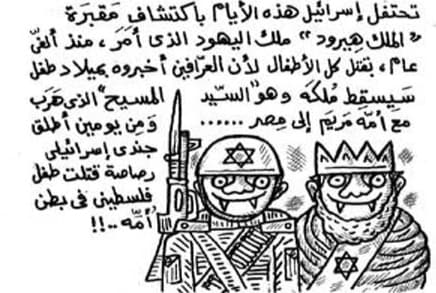
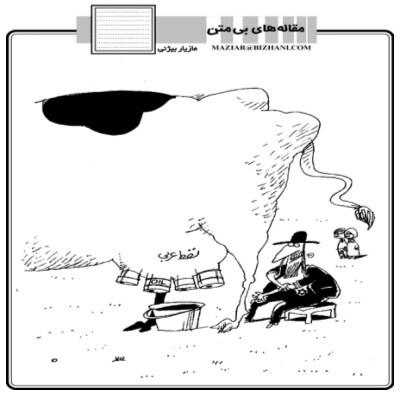
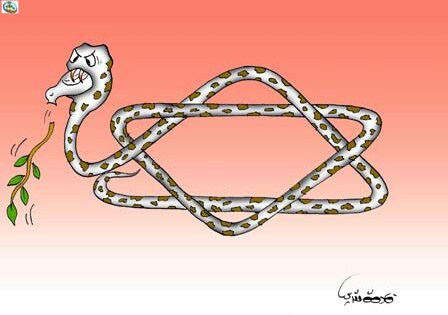
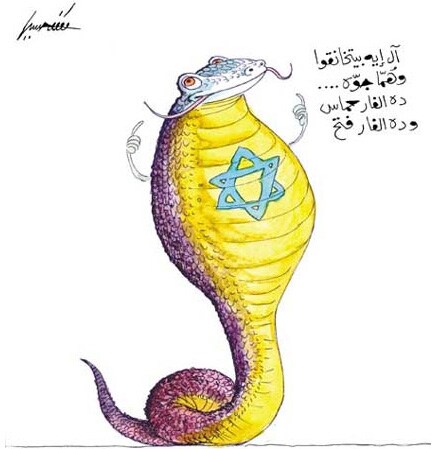
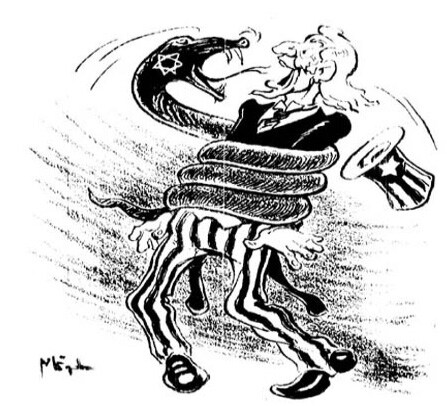
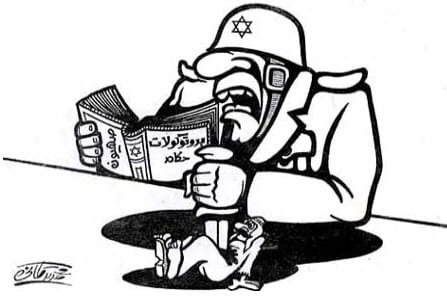
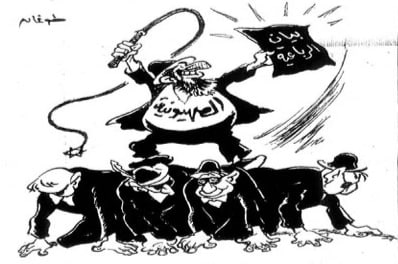
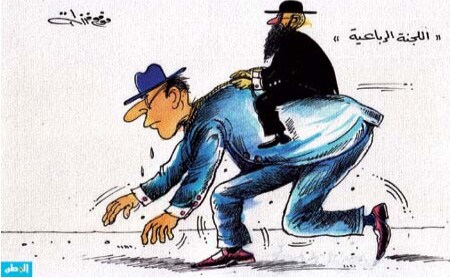
As Sally Fields might say They Hate us..they REALLY hate us. Anti-Semitism is still rampant in the Arab Media. and while you might expect it from Syria and Iran one of the biggest offenders is the supposedly moderate Arab country, Egypt. One of Israel's only "friends" in the Arab world. As the saying goes, with friends like these. MEMRI has posted a series of hateful cartoon that have run in the Arab Press. Cartoons that have depicted Jews a the big nosed Shylock characters and Snakes that portray Jews as Money Hungry or War Mongers who are trying to take over the world.

Antisemitic Cartoons in the Arab and Iranian Press

By: O. Winter

The following is a sample of cartoons from the last few months:

The Jews as the Killers of Christ

Cartoon No. 1: "Israel is celebrating the discovery of the tomb of King Herod, the Jewish king who ordered, two thousand years ago, to kill all the children because soothsayers had foretold that a child would be born who would topple him from the throne. [This child] was the Messiah who fled to Egypt with his mother, Mary. And two days ago an Israeli soldier shot and killed a Palestinian child in his mother's womb!!"

Source: Al-Ahram (Egypt), May 12, 2007.

The Jews as Plunderers of Resources

Cartoon No. 2: The cow's udder is labeled "Arab oil."

Source: Kayhan (Iran), February 17, 2007.

The Jew as a Serpent

Cartoon No. 3:

Source: Oman (Oman), April 19, 2007.

Cartoon No. 4: The mice in the snake's mouth represent Fatah and Hamas.
The snake is saying "imagine how they must be fighting each other in there.'"

Source: Akhbar Al-Yawm (Egypt), June 20, 2007.

Cartoon No. 5:

Source: Al-Gomhouriyya (Egypt), March 17, 2007.

The Jews as Taking Over the World

Cartoon No. 6: The title of the book is "The Protocols of the Elders of Zion"

Source: Teshreen (Syria), March 7, 2007.

Cartoon No. 7

Source: Al-Rai (Jordan), March 4, 2007.

Cartoon No. 8: A figure labeled "Zionism" holds up a whip and a document
titled "The Quartet Statement."

Source: Al-Gomhouriyya (Egypt), June 2, 2007.

Cartoon No. 9: "The Quartet"

Source: Al-Watan (Saudi Arabia), March 7, 2007.

The Jews as Warmongers

Cartoon No. 10: The sign beside the door says "Hamas-Fatah."

Source: Al-Watan (Qatar), March 2, 2007.

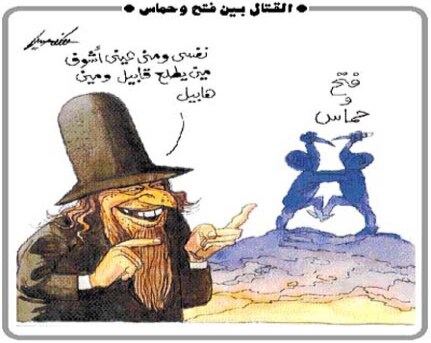
Cartoon No. 11: The figures fighting in the background are labeled "Fatah and Hamas." The Jew is saying: "I'd like to know which one of them will turn out to be Cain, and which will turn out to be Abel [i.e., which will end up killing the other]."

Source: Akhbar Al-Yawm (Egypt), May 21, 2007.

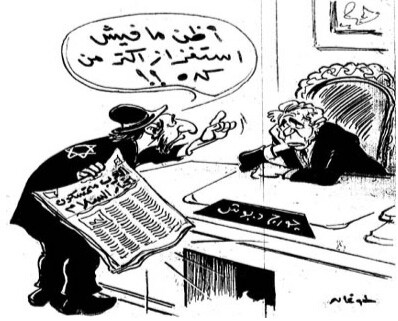
Cartoon No. 12: The newspaper headline says: "The Arabs are
Pursuing the Peace [Process]." The Jew is saying to George Bush:
"There is no provocation greater than this!!"

Source: Al-Gomhouriyya (Egypt), April 1, 2007.

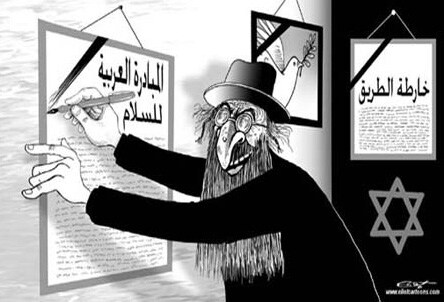
Cartoon No. 13: The document hanging on the right is titled
"The Road Map"; the one hanging on the left is labeled "The Arab Peace Initiative."

Source: Al-Watan (Qatar), April 2, 2007

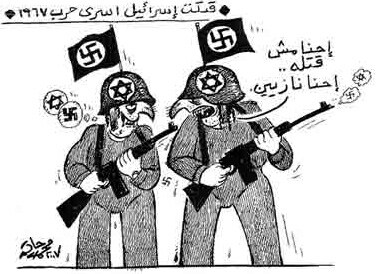
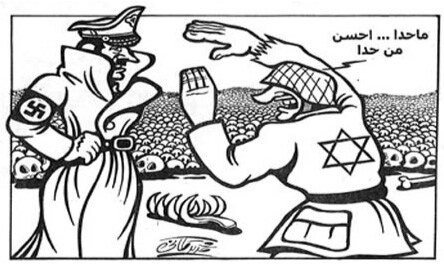
The Jews as Nazis

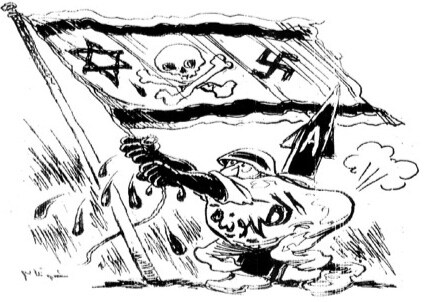
Cartoon No. 14: The figure is labeled "Zionism"

Source: Al-Gomhouriyya (Egypt), March 6, 2007.

Cartoon No. 15: "Israel Killed [Egyptian] Prisoners of War in 1967"
The figure on the right is saying: "We are not murderers, we are Nazis."

Source: Al-Ahali (Egypt), March 21, 2007.

Cartoon No. 16: "Washington: We Will Preserve Israel's Military Superiority over All the Countries in the Region."

The American is saying: "So that it can fight terrorism effectively." The box in his hands is labeled "ammunition."

Al-Ahali (Egypt), April 18, 2007.

Cartoon No. 17: The Israeli is explaining to the Nazi: "We are the same."

Source: Teshreen (Syria), April 26, 2007.

*O. Winter is a research fellow at MEMRI.