Please Hit

Folks, This is a Free Site and will ALWAYS stay that way. But the only way I offset my expenses is through the donations of my readers. PLEASE Consider Making a Donation to Keep This Site Going. SO HIT THE TIP JAR (it's on the left-hand column).
Showing posts sorted by relevance for query salazar. Sort by date Show all posts

Wednesday, January 6, 2010

Obama's New Drilling Regulations Will Make Us MORE DEPENDENT ON FOREIGN OIL

The Obama administration cynically tells us we need to reduce our dependence on foreign oil, while they have done everything they can to delay or stop us from tapping our own energy resources still in the ground. One of Ken Salazar's first acts as Secretary of Interior was canceling 77 Utah oil and gas leases that had gone through seven years of studies, negotiations and land-use planning. In an instant, he eliminated hundreds of jobs, terminated access to vital oil and gas deposits, and deprived taxpayers of millions in lease bonus, rent, royalty and tax revenues. In short he was making us more defendant on foreign oil instead of exploiting our reserves which are larger than any other country on this planet.
...Congressional Research Service (CRS) sheds light on the true picture of America's energy resources. The comprehensive assessment looks beyond the Energy Information Administration's estimates of proven reserves to include government estimates from the U.S. Geological Survey and the Minerals Management Service to include America's recoverable oil resources from areas both accessible and inaccessible to drilling. The results show the U.S. endowment of recoverable oil to be 167 billion barrels of oil, not 21 billion - nearly eight times higher than the number pedaled by Democrats. Remarkably, 167 billion is the equivalent of replacing America's current imports from OPEC countries for more than 75 years.
The President's refusal to tap our own energy reserves hurts us on a an economic and nation security basis, it takes the "weapon" of an oil cutoff and oil revenues out of the hands of those who would blow us up. If President Obama truly gave a rats arse about becoming energy independent, he would allow off-shore and oil shale drilling.

POTUS Obama does not really care about becoming energy independent, as Secretary of Interior Salazar announced new regulations today that will slow down the tapping of America's vast Reserves.


The Obama administration will expand environmental reviews before leasing federal lands to the oil and gas industry, Interior Secretary Ken Salazar announced Wednesday.

The environmental studies are one of several new policies announced by Salazar that drew immediate rebukes from the industry and highlighted the shift at Interior from the Bush administration, which was close to oil and gas companies.

Salazar highlighted the contrast with the last administration, and hailed the expanded environmental studies as evidence that oil companies have seen their influence on federal leasing decisions wane.
“The difference is that under the prior administration, the oil and gas industry were essentially the kings of the world. Whatever they wanted to happen essentially happened. This department was essentially a handmaiden of the oil and gas industry,” he said on a conference call with reporters.

“We have brought that to an end."

Under the new procedures announced by Salazar, Interior staff will conduct more detailed reviews of whether development would be harmful to lands and wildlife, including more on-the-ground visits.
The policies also pare back waivers from environmental analysis for some oil and gas activities that were authorized under a major 2005 energy law, and emphasize leasing in already-developed regions rather than new areas. The new policies will affect leasing and development decisions in energy-rich states where the federal government is a major landowner, including Colorado, Utah and Wyoming.
In other words, last year's slogan has been changed to Drill Where, Drill Later.
Industry groups said the shift would hurt the economy and make it more difficult to lessen U.S. dependence on foreign energy sources.

“In what has become increasingly familiar double-talk from this administration, Interior Secretary Salazar today again spoke of the importance of domestic oil and natural gas, while making it more difficult to produce American oil and gas, put more Americans back to work and help restore our nation’s economy,” said Jack Gerard, president of the American Petroleum Institute, the industry’s biggest trade group.

“Under the guise of offering certainty for investors, Interior Secretary Salazar has taken steps to further delay and limit American energy resources for all Americans,” he added.

An alphabet soup of other industry groups — the Independent Petroleum Association of Mountain States, the Consumer Energy Alliance and the Independent Petroleum Association of America — issued similar statements alleging the plans would stymie development.

....But Sen. Lisa Murkowski (R-Alaska), the Senate Energy and Natural Resources Committee's top Republican, criticized the new policies.

“Interior Secretary Salazar claims the changes announced today will provide certainty, but the only certainty they provide is that more production will be driven overseas,” said Murkowski spokesman Robert Dillon.
In the end our President is working to keep one of his promises, the one were he said that Energy prices will sky rocket.


Monday, March 7, 2011

Interior Secretary Salazar Gets Visit From The Stupid Fairy

If you were in Washington DC last week, you may have seen an extra twinkling object in the night sky over the building that houses the Department of Interior. Some claimed that it was a UFO, but that is a false claim  That twinkle was just the Fairy of Stupidity spreading his stupid dust over the office of Interior Secretary Salazar...And that fairy dust is working very well on the Secretary, maybe too well.

On Friday, Salazar was asked why  the Obama administration opposes drilling in the Arctic National Wildlife Refuge (ANWR) given the rising cost of gasoline, the Interior Secretary answered that the “drill, baby, drill program” is not going to lead the United States to energy independence.
“We don’t believe that you need to drill everywhere and we don’t believe that the 'drill, baby, drill' program is the way that’s going to get us to the energy independence that we need for America or that will power our economy and that’s why the President has been so clear from day one and we in the Department of Interior have been so clear that what we need to do is need to have a robust energy program that includes a number of different sources of energy and while yes, we are pushing forward with oil and gas development both offshore and onshore which was the subject of much of the hearing today, we’re also moving forward with renewable energy,” he told CNSNews.com after testifying before the House Natural Resources Committee about his Department’s FY2012 budget.
“The President has said we are supporting nuclear, we’re support other clean air energy forms and at the end of the day, this is a place where there is hope that perhaps some of the Republicans in the House would come together and say that we can move forward with energy legislation that moves us into this new energy future.”
Instead of using facts, the Interior Secretary is using spin and hyperbole. Here are some of  the facts about Anwr.
  • The Coastal Plain of ANWR is America's best bet for the discovery of another giant "Prudhoe Bay-sized" ail and gas field in North America. Many economic benefits would result:
  • The Coastal Plain could produce up to 1.5 million barrels per day for at least 25 years - nearly 25% of current daily U.S. production.
  • The U.S. would save $14 billion per year in oil imports.
  • Between 250,000 and 735,000 jobs are estimated to be created by development of the Coastal Plain.
  • Federal revenues would be enhanced by billions of dollars from bonus bids, lease rentals, royalties, and taxes.
More than 75 percent of the citizens of Alaska, the Alaska legislature, the governor, the congressional delegation, and the residents of the North Slope Borough ( including those who live in the only village in the refuge ), support Coastal Plain oil and gas development All necessary government resource evaluations have been completed. It is time far Congress to authorize this exploration and development.

Will Anwr totally solve our energy problems? No, but it will certainly help a heck of a lot. As Interior Secretary, Salazar should know that...unless he was sprinkled with stupid dust.
“What I say is what the White House would say and that is that we are moving forward with an effort to stand up oil and gas drilling in the deep oceans of the gulf and are doing it in a safe and orderly way and that’s reflected in the budget request that we were defending for the President today,” he said.


Lets talk about off shore, while its true the Dept.of Interior awarded its first off-shore contract since the BP disaster, but at the same time they are going to court to delay the awarding of other leases.

Two days after the White House said it would comply with a federal judge's ruling forcing the administration to act on offshore drilling permits, the Obama administration announced tonight that it will now appeal that ruling.

On Wednesday of this week, Deputy Secretary of Interior David Hayes told Congress: "We will comply with the court order and make the decision, up or down, on the pending permits."

That statement came 48 hours after Interior announced it was granting its first deep water drilling permit in nine months, an event that Michael Bromwich, director of the Bureau of Ocean Energy Management, Regulation, and Enforcement, hailed as a "significant milestone." Bromwich also said he expected "further deepwater permits to be approved in coming weeks."

Late this evening, however, President Obama's Department of Interior -- led by Ken Salazar -- announced it had decided to appeal the court's decision, a reversal of opinion that will only further delay the timely and responsible processing of permits for American energy production.
 As Oil prices continue to spike up, our government is doing whatever it can to stop the US from becoming energy independent. The real question is are they doing it on purpose, or are they just suffering from a sprinkling of dust from the stupid fairy?

Wednesday, March 4, 2009

What Ever Happened to Drill Here Drill Now ???

Last week when President Obama laid out his budget the message he gave was very clear. The President willing to drastically mess with the economy to protect the environment. Obama keeps making the excuse that alternative fuel sources will help free us from foreign oil suppliers.  That claim was just another lie by the President. At the same time he was making his speech his secretary of the interior was canceling 77 Utah oil and gas leases that had gone through seven years of studies, negotiations and land-use planning. In an instant, he eliminated hundreds of jobs, terminated access to vital oil and gas deposits, and deprived taxpayers of millions in lease bonus, rent, royalty and tax revenues. In short he was making us more defendant on foreign oil.


The Fact that President Obama refuses to admit is that he can make America Engergy independant with some congressional cajoling and a stroke of the pen.

There is anywhere from 18-95 BILLION Barrels of oil underneath our continental shelf. There is almost 7 TRILLION Barrels of Oil in the shale under the Rocky Mountains (to be fair, with present technology we can only get to around 800 billion barrels of it.  Today America Consumes about 20 Million Barrels/day approximately 7.5 million of which we get domestically. My math tells me, using the minimum numbers (18+800 Billion- to 95 to 7,000) divided by 20 million, divided by 365 days, the US has an import free Oil reserve of 112 -972 YEARS. Or putting it another way, if we started drilling now, the NY Jets might win another Super Bowl before we run out of domestic oil:

Destroying Both Jobs And Energy Security 
By NEWT GINGRICH AND ROY INNIS 
Who is really in charge of our public lands and resources? The American public — or the radical left?

The recession continues to worsen. Stores and companies are closing their doors. Millions are unemployed. Families are struggling to pay for homes, food, cars and fuel.

President Obama just signed a controversial, pork-laden, trillion-dollar "stimulus" package. We'll spend another $350 billion this year on imported oil.

And with the stroke of a pen, Interior Secretary Ken Salazar canceled 77 Utah oil and gas leases that had gone through seven years of studies, negotiations and land-use planning. In an instant, he eliminated hundreds of jobs, terminated access to vital oil and gas deposits, and deprived taxpayers of millions in lease bonus, rent, royalty and tax revenues.

The canceled leases represent one-third of acreage estimated to contain enough oil to fuel 3 million cars and enough natural gas to heat 14 million homes for 15 years. They were rejected because temporary drilling operations might be "visible" from several national parks more than a mile away.

Secretary Salazar is supposedly a moderate on land use and energy development. But this decision, after one week in office, suggests that he actually has strong anti-energy attitudes — or is too easily "persuaded" by environmental pressure groups.

They've already eliminated logging and mining in most of the West. They're now going after oil, gas, coal, oil shale and uranium — and after that ranching and snowmobiling.

Anti-energy zealots always say these areas only have three weeks or, at most, a few months of oil. But by this logic, why conserve, recycle or reduce pollution? Your personal contribution is trifling. Why plant corn or wheat? Your fields won't make a dent in world hunger.

Obviously, it's the cumulative impact that matters.

According to a 2008 Interior Department "inventory" of federal energy resources, 163 million acres of public lands are off-limits to oil and gas leasing. That's more than the total area of Montana and Wyoming combined.

These land withdrawals make 62% of the oil and 41% of the natural gas in our nation's onshore public lands unavailable — along with the jobs and revenues that developing these vital resources would provide. Another 65 million acres are severely restricted — for an additional 30% of our onshore federal oil and 49% of our gas.

That's right. An area the size of Texas and Oklahoma, 92% of our onshore publicly owned oil, and 90% of our onshore natural gas — are off-limits to Americans suffering through this recession.

This precedent to cancel leases (or never issue them), because drilling rigs might be visible from park and wilderness areas, threatens to make millions of additional acres off-limits. Such shortsighted actions will destroy jobs and drive up energy prices and the cost of everything we eat and do.

Offshore, Secretary Salazar has stalled oil and gas drilling yet again, by extending the comment period of the current leasing plan another eight months. Americans rose up successfully during the summer of 2008, to end the decades-long congressional offshore drilling ban, because it was bad policy. Salazar's actions suggest we might be headed toward new anti-energy policies.

Protecting the environment is crucial. And most people understand that, thanks to modern technologies, we can be pro-energy and protect the environment simultaneously.

For instance, while the left incites fear about offshore oil spills, the facts clearly show that current drilling techniques are enormously successful and incredibly safe. The same is true onshore.

In fact, three-fourths of Americans want more drilling, not less. They want out of this recession. They don't want it prolonged with anti-energy, anti-job, anti-revenue policies imposed on us by the radical left.

In the current economic gloom, there is no reason to revert back to the destructive policies that gave us $4-per-gallon gasoline and record-high heating bills.

Every American who supports a pro-energy agenda should contact the Department of the Interior (http://www.doi.gov/contact.html or 202-208-7351) and tell Secretary Salazar that developing all of our energy resources is the only reasonable option, if we want to create American jobs, improve the American economy, and support American national security.

Gingrich is a former speaker of the U.S. House of Representatives and chairman of American Solutions for Winning the Future.

Innis is chairman of the Congress of Racial Equality and author of "Energy Keepers — Energy Killers: The New Civil Rights Battle."

Monday, February 15, 2010

Obama's Restrictive Drilling Policy Will Rob $2.36 TRILLION From US GDP

The Congressional Research Service (CRS) sheds light on the true picture of America's energy resources. Their assessment looks beyond the Energy Information Administration's estimates of proven reserves to include government estimates from the U.S. Geological Survey and the Minerals Management Service to find the United States total reserves. The results show the U.S. reserves of recoverable oil to be 167 billion barrels of oil, not 21 billion - nearly eight times higher than the number pedaled by Democrats. Remarkably, 167 billion is the equivalent of replacing America's current imports from OPEC countries for more than 75 years.

Despite what the President said in his State of the Union Address, the Obama administration is doing what ever they can to prevent this country from becoming energy independent by harvesting our own reserves.
Hopes that America would soon develop vast untapped energy reserves were dashed when the incoming Obama administration ordered all federal agencies and departments to halt all such pending regulations until they could be reviewed by incoming staff. Incoming Interior Secretary Ken Salazar extended the public comment period by 180 days.
Last April, Salazar said President Obama told him regarding the comment period "to make sure that we have an open and transparent government" and to make sure that DOI was "maximizing the opportunity for the public to give us guidance on what it is they want us to do" about expanding domestic energy exploration and development.
The Interior Department announced in September it had received more than 530,000 comments... It's now four months after the close of this extended comment period, so where are the results? What happened to the open and transparent process?
Transparency right? It gets worse, they knew the results showed the comments reflected people wanted the drilling by a 2 to 1 margin. The White House didn't get the results it wanted, so the Dept. of Interior called for more investigations.
Instead, on Jan. 6 Salazar announced plans, as the energy news service Greenwire put it, that "will require more detailed environmental reviews, more public input and less use of a provision to streamline leasing." In other words, we were being promised more stalling, not more drilling.
A new report says the Obama/Salazar oil-and-gas drilling bans will raise consumer energy costs and decrease cumulative U.S. GDP by $2.36 trillion over the next two decades (full report below). That’s an average annual GDP drop of roughly.5%, it will also result in $4,400 average loss in real disposal income. The report, presented to nation’s State utility regulators in Washington has identified trillions of dollars of impact resulting from President Obama's strategy of continued reliance on foriegn oil.
SAIC’s NEMS-NARUC model results determined that maintaining traditional energy exploration and production moratoria on Federal lands would result in an alternative domestic energy future that, “…increases the cost and restricts the availability of domestic oil products and natural gas…” in all economic sectors and regions of the country.  According to the study, under the “Combined Comparative Case”, which combines the estimated increase in the oil and gas resource base with maintaining moratoria from 2009-2030, model projections show that :
  • Cumulative domestic oil and natural gas production decreases by 15% and 9%, respectively.
  • Average natural gas price increases by 17% and average electricity prices increase by 5%.
  • Cumulative national real disposable income decreases by $1.163 Trillion ($4,500 per capita).
  •  GDP decreases cumulatively by $2.36 Trillion ($1.16 Trillion NPV), an average annual decrease of 0.52%
  • Cumulative oil imports from OPEC countries increase by 4.1 Billion barrels.
  • Cumulative national payments to OPEC countries increase by $607 Billion ($295 Billion NPV).
  • If resources within the moratoria areas are not developed, there would be no new environmental effects within the U.S. jurisdiction attributable to development of those resources.  However, as a non-modeled item, the study observes that there could be environmental effects on domestic and international waters as a result of increased tanker transport of oil and gas imports and unknown environmental effects in countries from which the U.S. would import the resources.
An executive summary of the report is embedded below:

Monday, February 8, 2010

Transparency??? The President's Blocking Off Shore Drilling And Not Telling US

During his State of the Union Address President Obama gave us hope that the US would finally tap its own resources to make us energy independent:
But to create more of these clean energy jobs, we need more production, more efficiency, more incentives. That means building a new generation of safe, clean nuclear power plants in this country. It means making tough decisions about opening new offshore areas for oil and gas development. It means continued investment in advanced biofuels and clean coal technologies
Sadly like most of the promises coming from this President this pledge came with an expiration date. Only this expiration had a short window, only five days. When President Obama sent out his budget, it showed a decline in revenue from oil land leases, meaning he planned to be more restrictive in allowing off-shore-drilling than before.

But, as Billy Mays used to say, there's more.
On its last business day in office, the Bush administration published a proposed draft of a five-year plan to lease areas in the Atlantic and Pacific waters for oil and natural gas drilling. The plan authorized 31 energy exploration lease sales between 2010 and 2015 for tracts along the East Coast and off the coasts of Alaska and California.
Hopes that America would soon develop vast untapped energy reserves were dashed when the incoming Obama administration ordered all federal agencies and departments to halt all such pending regulations until they could be reviewed by incoming staff. Incoming Interior Secretary Ken Salazar extended the public comment period by 180 days.
Last April, Salazar said President Obama told him regarding the comment period "to make sure that we have an open and transparent government" and to make sure that DOI was "maximizing the opportunity for the public to give us guidance on what it is they want us to do" about expanding domestic energy exploration and development.
Well, the public provided no small amount of guidance. The Interior Department announced in September it had received more than 530,000 comments. It did not say, however, how many supported or opposed expanded drilling. It's now four months after the close of this extended comment period, so where are the results? What happened to the open and transparent process?
Transparency right? It gets worse, they knew the results showed the comments reflected people wanted the drilling by a 2 to 1 margin. The White House didn't get the results it wanted, so the Dept. of Interior called for more investigations.
Instead, on Jan. 6 Salazar announced plans, as the energy news service Greenwire put it, that "will require more detailed environmental reviews, more public input and less use of a provision to streamline leasing." In other words, we were being promised more stalling, not more drilling.
Former House Speaker Newt Gingrich's group, American Solutions, wanted to know and filed a Freedom of Information Act request on the comment period tabulation on Oct. 26, 2009. After weeks of delay and a second FOIA request, some 500 pages of e-mails were received from the DOI's Minerals Management Service (MMS).
Gingrich's group had heard from sources that the result of the tabulation was a 2-to-1 lopsided victory for expanded drilling. An e-mail dated Oct. 27, 2009 from MMS Director Liz Birnbaum to other senior MMS and DOI officials, including Salazar's chief of staff, confirmed the result and discussed ways of hiding it from the American people.
The e-mail reads, in part: "We do have a preliminary tabulation of the comments, (but) it has not yet gone to the Secretary. So the Secretary can honestly say in response to any questions that he's (sic) has not yet seen any analysis of the comments — staff is still working on it. I did, however, confirm to him the 2-1 split these guys (American Solutions) are emphasizing."
A recent Congressional Research Service Report says that if all our energy resources are added up and converted to a barrels-of-oil equivalent, the U.S. has the largest energy reserves in the world. "Our overwhelming coal, natural gas and oil resources represent tens of trillions of dollars in wealth and millions of American jobs," said Sen. James Inhofe, R-Okla., who, along with Sen. Lisa Murkowski, R-Alaska, released the report last fall.
The American people support increased domestic energy development by the same numbers and with the same fervor as they opposed the nationalization of health care. Certainly we need the domestic energy. Yet in both cases the administration dismisses the will of the people.

In this case, it's sitting not only on vast stores of energy, but on the truth about what the people want.
Just like the Obamacare debate, the President is pushing a policy which goes against the will of the American People. This time the policy is being being implemented even more secretively than Obamacare.  Instead of making the country energy independent, and creating jobs during a recession, this president is chasing the Hoax of global warming and passing up an opportunity to help our economy.

Tuesday, July 6, 2010

WSJ Report Says Obama Could Have Prevented Gulf Spill Disaster

The Obama administration blames former president George W. Bush for everything from dandruff and "ring around the collar" to General McChrystal's insubordination and the Gulf Oil Spill.

When it come to the Gulf Oil Spill disaster, the usual Obama charge does not stick. Much of the criticism directed toward the president has surrounded his delay in cleaning up the spill (a delay that continues through today). What has not been widely reported is the fact that the Obama administration could have prevented the spill had it heeded a multitude of warnings. Today the WSJ is reporting that last April, over a year before the Deepwater Horizon blew up, the administration received a loud alarm about the dangers of offshore oil drillig.

The alarm was rung by a federal appeals court in Washington, D.C., which found that the government was unprepared for a major spill at sea, relying on an "irrational" environmental analysis of the risks of offshore drilling.


The April 2009 ruling stunned both the administration and the oil industry, and threatened to delay or cancel dozens of offshore projects in Alaska and the Gulf of Mexico.


Despite its pro-environment pledges, the Obama administration urged the court to revisit the decision. Politically, it needed to push ahead with conventional oil production while it expanded support for renewable energy.
Energy was not the only reason, there was also money:
Another reason: money. In its arguments to the court, the government said that the loss of royalties on the oil, estimated at almost $10 billion, "may have significant financial consequences for the federal government."
The U.S. Court of Appeals reversed its decision and allowed drilling in the Gulf to proceed—including on BP PLC's now-infamous Macondo well, 50 miles off the Louisiana coast.
Can't blame that one on Bush.
Still, the administration defends its intervention in the court case, and says the ruling made it look more cautiously at whether to open new areas to offshore drilling. It pins blame on the Bush administration for pursuing a policy for deep-offshore drilling "that was driven by one principle: open everything," said White House spokesman Ben LaBolt.
OK maybe they can.
Mr. Obama inherited a slew of energy challenges when he took office in early 2009. The agency within the Interior Department charged with overseeing the oil and gas industry, the Minerals Management Service, was reeling from scandals. An inspector general's report months earlier had described rigged contracts, drug use and sex between MMS employees and industry representatives.

Along with cleaning up the MMS, Interior had to wrestle with a five-year drilling plan the Bush administration had filed just days before leaving office. The plan sought to open the waters in most of the U.S. outer-continental shelf to oil and gas exploration between 2010 and 2015. The push into ever deeper waters in the Gulf, which began in earnest in the mid-1990s, reflected the reality that drilling in shallower waters was largely tapped out.
But at the same time the Obama administration canceled leases that would have allowed drilling on land.
The tensions in the administration's own deliberations were clear from the start. Mr. Obama's Interior secretary, Ken Salazar, quickly picked a fight with the oil industry when he retroactively withdrew 77 oil-and-gas lease sales in Utah that the Bush administration had approved in its final weeks. The move drew applause from environmentalists and criticism from oil companies.
This is not to say that the president was wrong to push off shore drilling, but he was wrong to ignore the warnings of April 2009 and he was wrong to cancel the leases for drilling on land.
To navigate Capitol Hill, the administration needed to strike a balance between the "green energy" projects favored by environmentalists and liberals, and the traditional oil and gas projects favored by Republicans, whose support would be crucial in the Senate. Continuing to promote offshore drilling was part of that bargain.


But the federal appeals court decision, which came just days after Mr. Salazar's tour, threatened to throw a wrench in that process. The case was brought two years earlier by indigenous Alaskans and a coalition of environmental groups. It challenged a Bush-era plan to lease large chunks of offshore Alaska to oil drilling.


The groups argued the strategy didn't adequately account for the whole range of environmental perils raised by oil drilling on the outer shelf.
The appeals court agreed, ruling that the federal program was based on "irrational" analysis. The government's own assessment, the court found, weighed only the impact of oil washing up on shorelines. In a foreshadowing of the post-spill debate, the court noted that the analysis didn't address the impact of a significant spill further out at sea.
At first, Mr. Salazar used the ruling as a way to draw a distinction between his approach and that of the Bush White House. Blasting what he called "the previous administration's failure to apply the law," Mr. Salazar said in a statement that he planned to "fix the problems" the court identified. He would do so not by firing managers or shaking up MMS, but by subjecting offshore drilling to heightened scrutiny. Those fixes, he said, would "put oil and gas leasing decisions back on a firm scientific footing."
All of this happened a year before the Deepwater Horizon disaster and there were warnings from other sources.
On Sept. 21, Jane Lubchenco, Mr. Obama's handpicked head of the National Oceanic and Atmospheric Administration, filed a lengthy comment on the Bush-era drilling plan still under review. She cited several concerns, including the government's tendency to underestimate the likelihood of oil spills and to downplay their potential environmental impacts. She also noted the government's penchant for cribbing from older, often outdated, environmental analyses.


She cited a Congressional Research Service study from earlier in the year. "The threat of oil spills raises the question," the report said, "of whether U.S. officials have the necessary resources at hand to respond to a major spill."
Is the Gulf Oil Spill the Obama Administration's fault? Not totally, nor is it totally the fault of George "W" Bush or previous presidents. Each of those presidents who prevented drilling on land or the inner continental shelf immediate shoreline deserve to share in the blame. But it is totally disingenuous for our Finger-pointer-in-chief to place the blame toward others when he shared in creating the problem.

Monday, January 26, 2009

The Hypocrisy of Ted Kennedy

Environmentalist Teddy Kennedy is working at his hypocritical best once again.  The Democratic Party Icon is all for alternate forms of energy, except in his back yard.

Cape Wind is proposing America’s first offshore wind farm on Horseshoe Shoal in Nantucket Sound. Miles from the nearest shore, 130 wind turbines will gracefully harness the wind to produce up to 420 megawatts of clean, renewable energy. The Cape Wind wind farm project would add power to the region's energy grid, and would slash dependence on oil.

In average winds, Cape Wind will provide three quarters of the Cape and Islands electricity needs a noble project right? Well not to Uncle Teddy. You see Teddy the Hypocrite doesn't want a wind farm in HIS back yard.

President Obama vs. Senator Kennedy
The challenge is blowin’ in the wind.

By Jim Geraghty

We’ll know within a month how sincere Pres. Barack Obama and Interior Secretary Ken Salazar really were in their promise to harness the wind to help meet the country’s energy needs: Sen. Ted Kennedy has de facto veto power over projects in his home state, and he’s trying to stop an initiative called Cape Wind. Obama’s administration faces a choice on the project, which would build 130 offshore wind turbines, each about 440 feet high, about five miles off the coast of Cape Cod—creating small blemishes on the gorgeous view from the Kennedy compound.

The project has been the biggest environmental and energy dispute in New England for the past decade, and provides a perfect illustration of how the nation’s byzantine regulatory and permit process can strangle projects. Cape Wind LLC filed the first permit application for this project with U.S. Army Corps of Engineers in November 2001. If Cape Wind received its final approval today, the project would have undergone a more comprehensive and rigorous permitting review than did any existing fossil-fuel or nuclear-power plant in New England.

The Interior Department’s Minerals Management Service announced Wednesday in the Federal Register that they’ve completed their environmental-impact review. On all kinds of criteria—noise, water quality, coastal vegetation, coastal birds, even the effect on plankton—the impacts were deemed negligible to minor. The MMS is expected to recommend whether to grant a lease to Cape Wind within the next 30 days.

A few hurdles remain. The project needs a final approval from the Massachusetts Energy Facilities Siting Board and permits from the Federal Aviation Administration and Coast Guard, and the Interior Department’s inspector general has been asked to examine the review process. But Cape Wind organizers feel they have cleared the most difficult hurdles, and expect to begin construction of the wind farm by the end of this year—and to be producing electricity by late 2011 or early 2012.

But Senator Kennedy issued a skeptical statement after Interior gave its positive assessment. “I do not believe that this action by the Interior Department will be sustained,” said Kennedy, going on to mention the Interior Department investigation and FAA permit approval. “By taking this action, the Interior Department has virtually assured years of continued public conflict and contentious litigation.”

It is hard to overstate Kennedy’s role in delaying Cape Wind thus far. Efforts in Congress to torpedo the project, often by stealthy legislative or regulatory means, have always come directly or indirectly from Kennedy’s office, project backers say. They add that Kennedy and his staff behave as if stopping their project is the senator’s top legislative priority.

Kennedy’s staff itself has been quick to insist that the senator’s disapproval stems from environmental and cost-benefit objections, not a personal desire to keep the waters off the Kennedy compound free of turbines. But the MMS report, oddly enough, specifically noted that the project would impede the view from the home of its most high-profile opponent: “Cape Wind will also have an adverse visual impact on 28 historic properties including the Kennedy compound, Nantucket historic district, Nobiska Point lighthouse, Monomoy Point lighthouse and several other light houses and proposed or existing historic districts.”

Also, Kennedy normally votes with environmentalists, and the project perfectly matches most green-minded lawmakers’ public statements about renewable energy. Traditional Democratic allies, including national environmental groups, organized labor, and even Greenpeace, back it. Supporters suspect that the opposition of Rep. William Delahunt, and the relative silence of other Massachusetts lawmakers such as Sen. John Kerry and Rep. Ed Markey (both frequently outspoken on environmental issues), stems from deference to Kennedy.

The perception among Cape Wind opponents is that the MMS report represents one final parting shot from their preferred villain, the Bush administration. Audra Parker, executive director of the anti-Cape Wind group the Alliance to Protect Nantucket Sound, told local media “the only reason this came out today was to get it done in the current Bush administration.”

Delahunt echoed that argument in his statement: “The Bush administration’s decision to issue the Final EIS on Cape Wind literally hours before leaving office—prior to issuing any standards to guide the review of these projects—comes as no surprise. The administration has put the cart before the horse and adopted an unprecedented approach that provokes more controversy and litigation; all for a $2 billion project that depends on significant taxpayer subsidies while potentially doubling power costs for the region.”

But the new administration might not bring change. Neither Obama nor Salazar has spoken publicly about Cape Wind specifically, but both have enthusiastically endorsed wind power in general. Obama pledged that the nation would “harness the sun and the winds and the soil to fuel our cars and run our factories” in his inaugural address—just a few days after he visited a factory in Bedford Heights, Ohio, that manufactures more of the bolts used to construct wind turbines than does any other factory in the U.S.

Salazar, at his confirmation hearing, pledged, “As part of the President-Elect’s energy team, I will work to modernize our interstate electrical grid, expand the use of renewable energy like solar and wind on public lands, and help tribes develop renewable energy resources on their lands.”

The upcoming decision puts Obama in his least favorite position: making a hard choice between two allies. Kennedy opposes it, but Massachusetts governor Deval Patrick supports it. Disapproval, or a sudden additional delay, would almost certainly represent an intervention by Salazar on behalf of Obama, and the administration would have to explain why their loud support for wind power—and touting of shovel-ready public-works projects—doesn’t include Cape Wind.

“There would have to be some extraordinary reason to not make a favorable decision, aside from deference to Ted Kennedy,” says one project ally who has watched the regulatory wrangling for years. “And if deference to Ted Kennedy is what delays this project, this means that deference is being paid by the president himself—and [that he’s] doing so at the expense of his pledges on energy policy.”

Wednesday, March 31, 2010

Obama's New Drilling Plan: a Combination of Lies and Sleight of Hand

Today President Obama announced the opening of some off shore sights on the east coast and Alaska. Even though it omits some of our most fertile drilling spots off the West coast and on the Alaskan mainland, most people will celebrate the President's action. But a closer look at the President's action shows that Obama "giveth with one hand and taketh away with the other"

The President started off his announcement with a lie.  He said that the US only has about 2% of the world's oil reserves.The Congressional Research Service (CRS) has light on the true picture of America's energy resources. The comprehensive assessment looks beyond the Energy Information Administration's estimates of proven reserves to include government estimates from the U.S. Geological Survey and the Minerals Management Service to include America's recoverable oil resources from areas both accessible and inaccessible to drilling. The results show the U.S. endowment of recoverable oil to be 167 billion barrels of oil, not 21 billion - nearly eight times higher than the number pedaled by Democrats. Remarkably, 167 billion is the equivalent of replacing America's current imports from OPEC countries for more than 75 years.
President Barack Obama is to announce Wednesday a plan to permit exploration for oil and natural gas off the coast of Virginia as a way to create jobs and reduce U.S. dependence on foreign oil.

Obama, who wants Congress to move a stalled climate change bill, has sought to reach out to Republicans by signaling he is open to allowing offshore drilling, providing coastlines are protected.

Joined by Interior Secretary Ken Salazar, Obama is to detail an updated plan for offshore oil and natural gas drilling in remarks at a military base in nearby Maryland.

For more than 20 years, drilling was banned in most offshore areas of the United States outside the Gulf of Mexico because of concerns that spills could harm the environment.

The administration has been weighing the pros and cons of offshore drilling since it took office and put the brakes on a Bush-era proposal which called for drilling along the East Coast and off the coast of California.

An administration official said, as part of the new plan, Interior will conduct the first new offshore oil and gas sale in the Atlantic Ocean in over two decades as part of a lease sale 50 miles off the coast of Virginia.

Seismic exploration in the south Atlantic and mid-Atlantic Outer Continental Shelf of the United States will determine the quantity and location of potential oil and gas resources to support energy planning.
Don't get too excited as you may remember in January the Interior Secretary Salazar announced new regulations to slow down the process of exploiting our oil reserves. Under the new procedures announced by Salazar, Interior staff will conduct more detailed reviews of whether development would be harmful to lands and wildlife, including more on-the-ground visits.


The policies also pare back waivers from environmental analysis for some oil and gas activities that were authorized under a major 2005 energy law, and emphasize leasing in already-developed regions rather than new areas. The new policies will affect leasing and development decisions in energy-rich states where the federal government is a major landowner, including Colorado, Utah and Wyoming.


It is expected that exploration to be announced today will face similar delays by the Interior department, as the object of this announcement is to give the President political cover for what will be coming later in the week


Here's a look at what the President is doing with the other hand:

Proposed oil and gas leasing in Alaska's Bristol Bay will be canceled out of concern for protecting sensitive areas of the Outer Continental Shelf from environmental dangers.

This could affect companies like Royal Dutch Shell which has expressed interest in the region, as well as Conoco Phillips, BP and Statoil.

Four pending lease sales in the Chukchi and Beaufort Seas in North Alaska will be canceled and those areas reserved for future scientific research to determine if they are suitable for further leasing. At the same time, a previously scheduled lease sale in Alaska's Cook Inlet will proceed.
And here is the "kicker." While the President will try to get the nation cheering about all of that new drilling (as if it will happen right away) his EPA will be ramping up the price of energy in a huge way.

Tomorrow, April 1, is the date the EPA is expected to announce all of its new regulations based on its declaration that CO2 is a pollutant.  These new regulations will be a back door energy tax that will not only kill jobs, but tax every American who turns on a light drives a car or warm their house. They will drive up the cost of consumer goods and drive jobs over sees as the new regulations will increase the cost of manufacturing products in America.

This action will hurt the middle class more than any other group. The rich will be able to afford the higher costs for goods and energy. Under an Obama administration the Poor will probably receive subsidies to help them afford the inflated costs. It the middle-class who can neither afford nor receive aid that will be most burdened by Obama's intentional energy inflation.

Sunday, May 15, 2011

Meet Obama's New Energy Plan, Same as The Old Plan

There seemed to have been a collective sigh of relief across the country. After over two years of waging war on domestic energy production which helped to boost gas prices over four dollars/gallon ($4.58 in my neighborhood), President Obama announced a new energy plan that would allow an increase and acceleration of domestic energy production.

Well...that's until one examines his words. That's when you realize that the POTUS left himself enough "outs" to make his plan worthless.
I am directing the Department of Interior to conduct annual lease sales in Alaska’s National Petroleum Reserve, while respecting sensitive areas, and to speed up the evaluation of oil and gas resources in the mid and south Atlantic.  We plan to lease new areas in the Gulf of Mexico as well, and work to create new incentives for industry to develop their unused leases both on and offshore.
Oh great! Finally drilling at ANWR? Not on your life. The National Petroleum Reserve is not ANWR it's next the desired drilling area.  Kind of  like telling a new president that instead of the White House he would have to live at 1700 Pennsylvania Avenue.

The President didn't mention drilling in ANWR, he said "respecting sensitive areas," which was a signal to the important environmentalist constituency, that he did not mean ANWR


The map above describes the ANWAR situation. ANWR sits within a 20 million-acre refuge (the size of South Carolina), but thanks to advanced technology like directional drilling, the aggregated drilling footprint (the dot pointed to by the arrow) would be less than 2,000 acres (about one-quarter the size of Dulles Airport). This is like laying a 2-by-3-foot welcome mat on a basketball court. That little oil field has
mean expected 10.4 billion barrels of technically recoverable oil, according to the government’s own survey. Once up and running, ANWR alone could yield one million barrels of oil per day in production, which would make it the single-largest producing field in North America.
According to environmentalists, a major progressive voting constituency, energy development, especially on that little one-hundredth of one percent of the ANWAR land cannot be compatible with the protection of  wildlife and their habitat. This is not true.

In the case of the Alaskan North Slope drilling,  caribou herds have grown and remained healthy throughout more than three decades of oil development.


His other words in the paragraph above were  speed up the evaluation of oil and gas resources in the mid and south Atlantic. With confidence I can tell Obama will follow these words to the letter.  Surely he will speed up any evaluation of our Oil and Gas resources to determine whether they represent viable spots for drilling.  What he will not do however, is speed up the long "environmental impact" process.

One of Ken Salazar's first acts as Secretary of Interior was canceling 77 Utah oil and gas leases that had gone through seven years of studies, negotiations and land-use planning. In an instant, he eliminated hundreds of jobs, terminated access to vital oil and gas deposits, and deprived taxpayers of millions in lease bonus, rent, royalty and tax revenues. In short he was making us more defendant on foreign oil instead of exploiting our reserves which are larger than any other country on this planet.

What Obama's Secretary of Interior did instead was to extend the environmental process. In January 2010, Secretary Salazar announced a new policy expanding environmental reviews before leasing federal lands to the oil and gas industry.


There was no mention of changing this delaying policy in his words yesterday. Dooming any potential new oil reserves to years of federal roadblocks.

There was also no mention by the President of our vast shale oil reserves.The Green River shale formation in Utah, Wyoming, and Colorado, has an estimated 800 billion barrels of oil, which is three times the proven reserves of Saudi Arabia. In the Bakken oil shale formation in the Dakotas, there are an estimated 20 billion barrels of oil.

What seemed as an epiphany  by President Obama yesterday was nothing of the kind, it was simply a collection of empty words, as was his earlier promise to lift his oil moratorium in the Gulf, which resulted only in decreased production and many of his other promises, such as his signature health plan not causing people change providers.

So at least with his words yesterday, President Obama's new energy plan is "same as the old plan."

I'll tip my hat to the new constitution
Take a bow for the new revolution
Smile and grin at the change all around me
Pick up my guitar and play
Just like yesterday
Then I'll get on my knees and pray
We don't get fooled again
Don't get fooled again
No, no!
Enhanced by Zemanta

Thursday, February 5, 2009

Obama Declares War On Fossil Fuels

Here is another example of what President Obama means by change.The new administration has wasted no time in canceling a decision by the Bush White House that let gas and oil companies explore for new resources. Remember when President Bush announced that he was lifting the ban on domestic drilling? That was way before the economy started tanking but it set oil prices on their downward trend. Now President Obama wants to send oil prices back through the roof to make sure that Al Gore and his global warming nuts gets their way with the American Economy. Higher Oil Prices, that is the Change Obama Promised:
War On Fossil Fuels
By INVESTOR'S BUSINESS DAILY


Interior Secretary Ken Salazar has canceled leases for energy exploration on 77 parcels of federal land in Utah, confirming that this White House is indeed a Small Oil administration.


The previous administration, which was not beholden to environmental special interests and seemed to understand the importance of energy, had released 130,000 acres of largely uninhabited — and uninhabitable — land for oil and gas exploration.


Some of the parcels are in or near the Green River Formation, an oil-rich region in Colorado, Utah and Wyoming that has the largest known oil shale deposits in the world, holding from 1.5 trillion to 1.8 trillion barrels of crude.


The entire reservoir can't be emptied overnight and injected into our energy-dependent economy tomorrow. But it is more readily available than the environmental groups want to admit.


"Even a moderate estimate," says the Energy Department's Argonne National Laboratory, indicates 800 billion barrels are recoverable. That amount alone makes the Green River Formation stock "three times greater than the proven oil reserves of Saudi Arabia."


The now-off-limits parcels not in the Green River Formation also hold "vast amounts of domestic, clean energy," according to the Independent Petroleum Association of Mountain States.


Democrats and Republicans both talk about energy independence, but one seems to do all it can to make sure the U.S. doesn't achieve it. That party lectures a lot about renewable and alternative energy but is hostile to cheap and readily available fossil fuels.


The justification is always environmental, which has an emotional appeal. But the green movement and its political allies have no sense of proportion. In the case of the 77 parcels pulled back by the administration, the pieces involved are minuscule specks of land.


While some aesthetic value might be spoiled, the impact would be limited, about the same as tossing a few grains of sand on a clean rug in the middle of a large living room.


Environmentalists like to say these sites belong to all Americans and should remain undeveloped. But if these lands truly belong to everyone, then they also belong to those who know that we will one day need the energy they hold.


Salazar acknowledges "we need to responsibly develop oil and gas supply to protect us from our dependence on foreign oil, but we need to do so in a thoughtful and respectful way."


In all due respect to our new energy secretary, he'll be foremost in our thoughts when America faces the next oil crisis.

Tuesday, July 13, 2010

Obama Scoffs at Court Decison Issues Harsher Drilling Ban

The Interior Department first issued a broad drilling ban in May, which was challenged by several Gulf coast companies that service the drilling industry, and was struck down in June by U.S. District Judge Martin Feldman, who said it was not justified. Last week a Federal Appeals court upheld Judge Feldman's decision striking down the President’s ban.

Rather than continuing the appeals process to challenge the ruling through the judiciary as called for by the constitution, the president directed the Secretary of the Interior to re-impose the ban with different language as a way of getting around the judge’s order.

This time Salazar will allow some rigs to resume drilling, providing the drilling rig had adequate plans in place to quickly shut down an out-of-control well, that the blowout preventers atop the wells it drills have passed rigorous new tests, and that sufficient cleanup resources are on hand in case of a spill.

According to Industry officials  it would be difficult to meet those conditions quickly, especially since the specifics of the new rule would not be issued for over a month. Therefore thousands of jobs could be lost, and as drilling rigs are moved to other countries chances are those jobs will be lost for a much longer than the 6 months of the ban.

Mr. Salazar directed federal regulators to come up with interim rules by the end of August that would clarify the steps needed to resume operations. But he made clear that most rigs would remain barred from drilling in deep water through November.

His department characterized the moratorium issued on Monday as a refinement of the previous one that was rejected by the courts, not a retreat from it.

“Like the deepwater drilling moratorium lifted by the District Court on June 22, the deepwater drilling suspensions ordered today apply to most deepwater drilling activities and could last through Nov. 30,” the Interior Department said in briefing materials on the new ban.

“The suspensions ordered today, however,” the materials said, “are the product of a new decision by the secretary and new evidence regarding safety concerns, blowout containment shortcomings within the industry and spill response capabilities that are strained by the BP oil spill.
Wasn't this the president who keeps on talking about getting off of foreign oil? That was just another Obama ruse.
The main lobby for the oil industry, the American Petroleum Institute, criticized the new order, saying it would worsen the economic hardship already being felt across the Gulf Coast.


“It is unnecessary and shortsighted to shut down a major part of the nation’s energy lifeline while working to enhance offshore safety,” Jack Gerard, the association’s president, said in a statement. “It places the jobs of tens of thousands of workers in serious and immediate jeopardy and promises a substantial reduction in domestic energy production. No certain and expeditious path forward has been established for a resumption of drilling.”
This new ban is just another example of Obama as the Imperial President. Sacrificing an entire industry and people's livelihoods in order to gain what he really wants, a ban on drilling and cap and trade tax.

Monday, March 28, 2011

Obama Loses Washington Post Support For His Energy Policy

Now he has done it.  President Obama has alienated the Washington Post, the Washington home of the progressive movement. After two years of sabotaging America's efforts to become energy independent by exploiting its own energy resources, the President went to Brazil last week where he promised to help fund it's oil exploration and promising that we would be their best customers. 
By some estimates, the oil you recently discovered off the shores of Brazil could amount to twice the reserves we have in the United States. We want to work with you. We want to help with technology and support to develop these oil reserves safely, and when you're ready to start selling, we want to be one of your best customers. At a time when we've been reminded how easily instability in other parts of the world can affect the price of oil, the United States could not be happier with the potential for a new, stable source of energy.
WAPO, Obama's home town paper has accused the POTUS of changing the chant from "Drill Here Drill Now" to "Drill THERE, Drill now:
Brazil is probably a more stable, secure supplier than, say, Libya. Still, the president’s words were ironic. Brazil already produces vast quantities of a fuel — ethanol — that the U.S. government, under a policy long supported by presidents and farm-state members of Congress from both parties, has promoted as a green alternative to gasoline. But the United States, protecting its own heavily subsidized ethanol industry by means of a 2.5 percent tariff and a 54-cent-per-gallon duty, prevents Americans from importing all but trivial amounts of the stuff from Brazil. Therefore, we need more oil — much of it imported. In Brasilia, Mr. Obama spoke of strengthening U.S.-Brazilian technical cooperation on ethanol but did not propose allowing U.S. protectionist measures to lapse after their scheduled expiration on Dec. 31.

As for offshore drilling, Mr. Obama’s enthusiasm for punching holes in the ocean floor off Brazil is hard to reconcile with his decision, announced Dec. 1, to keep the waters off the East and West coasts and the eastern Gulf of Mexico off-limits to exploration indefinitely. His policy was a reversal of an earlier decision he had made to open some of those areas. We can understand that reversal, after the massive oil spill in the western Gulf last year. And, demonstrating a measure of flexibility even after the disaster, the administration has announced five deep-water drilling permits in the western Gulf since the spill.
Actually only two of those permits were new, the other three were leases that were on hold because of the BP freeze.
Privileged residents of scenic landscapes in America have long cried “NIMBY” — “Not In My Back Yard” — to stave off unwanted but necessary projects, from railway tracks to wind farms to power lines. Now NIMBY-ism, it seems, has become U.S. policy on offshore oil production. But the Nigerias, Angolas and Brazils of the world do not have that luxury. This makes no sense, economically or environmentally, and, sooner or later, a more balanced view must prevail.
 What the Washington post didn't mention is all the anti-drilling moves made since Obama was inaugurated. One of the first actions the Obama team took when it assumed office in was to direct Secretary of the Interior Salazar to cancel 77 oil and gas leases in Utah. The next year they canceled 61 onshore leases in Montana.

President Obama has also repeatedly delayed exploration plans for America’s oil shale resources, which contain more than three times as much oil as there is in Saudi Arabia. At the same time one of our allies Israel, has developed technology to make shale oil drilling cheaper and cleaner,  this will be used for Israel to extract its vast shale oil resources.

One of the Administration's "misstatements" is  US oil production is at its highest point in seven years. That was both incorrect and misleading.  Daily average production of oil last year 5,361,000 barrels/day the best since 2005's 5,419,000/day. The real misleading fact about his statement, is that neither year is even close to levels seen only ten years before when production was 20% higher.


The President mentioned 35 offshore contracts were awarded, hiding the fact that off shore oil production has been way down since 2005, and that production took a big drop as soon as Obama took office (even before BP). Out of those 35 contracts, 33 were existing contracts that were stopped because of BP and allowed to restart.


Source for both charts above the US Energy Information Administration.

The administration grossly underestimates America's oil supply,  saying that we only have 2% of the worlds supply.

That particular number is America's proven reserves where we are already drilling. It does not include the 10 billion barrels available in the Arctic National Wildlife Refuge. It does not include most of the 86 billion barrels available offshore in the Outer Continental Shelf, most of which President Obama has placed under an executive drilling ban. And it does not include the estimated 800 billion barrels of oil we have locked in shale in Wyoming, Utah, and Colorado. Those shale resources alone are actually three times larger than the proven reserves of Saudi Arabia, so the claim that the U.S. only has 2% of the world's oil is clearly false.

A 2009 study by the non partisan Congressional Research Service (CRS) sheds light on America's energy resources. It shows show the U.S. supply of recoverable oil to be 167 billion barrels of oil, the equivalent of replacing America's current imports from OPEC countries for more than 75 years. And that's just the oil, when you include gas and coal, the U.S.  has energy reserves the equivalent of 1.3 trillion barrels


On top of that there is more Oil to find. For example, in 2008 the US Geological Survey announced that the Arctic holds about 90 BILLION barrels of Oil, more than Nigeria, Kazakhstan and Mexico combined about one third of the reserves are in Alaskan waters.  In the graph below the darker the blue the better the probability of Oil. In the map below the darker the green the more oil. The Dark green area between five and six o'clock is in Alaska territory, which is just under 30 Billion Barrels of Oil. And just like anything else in this world, politics will play a huge part in how soon we can get to it


The administration tries to deflect criticism by saying the oil industry holds leases on tens of millions of acres both offshore and on land where they aren't producing a thing. The President has said he wants to "encourage companies to produce [on] the leases they hold."

If Obama is telling the truth, those oil companies must be run by idiots why else would they pay for leases but they refuse to make money so they leave the product in the ground. Thankfully for those who hold stock in big oil, the companies aren't run by idiots. The fact is   the President thinks the American people are idiots and will believe this particular pack of horse hooey.

A lease is for exploration and production, not just production, and because oil is not equally distributed across the globe, one parcel of leased acreage may not hold any oil. Moreover, due to government red-tape, which has gotten more complected under the Obama administration, it can take years for companies who own a lease to complete their exploration activities. To get to the production phase, it could take as long as ten years. Ironically, President Obama wants to tax companies for not producing on their leases, even if the federal government's refusal to grant permits is the reason why those companies are not drilling.

The truth is, ever since Barack Obama took office the President has been making it more difficult to exploit our own energy resources and now it seems as if President Obama's energy policy consists of making America more dependent on foreign oil. If today's Washington Post is indication, the left may be waking up.

Wednesday, March 19, 2014

Sen. Udall Pressured State Agency to Change Obamacare Cancellation Numbers

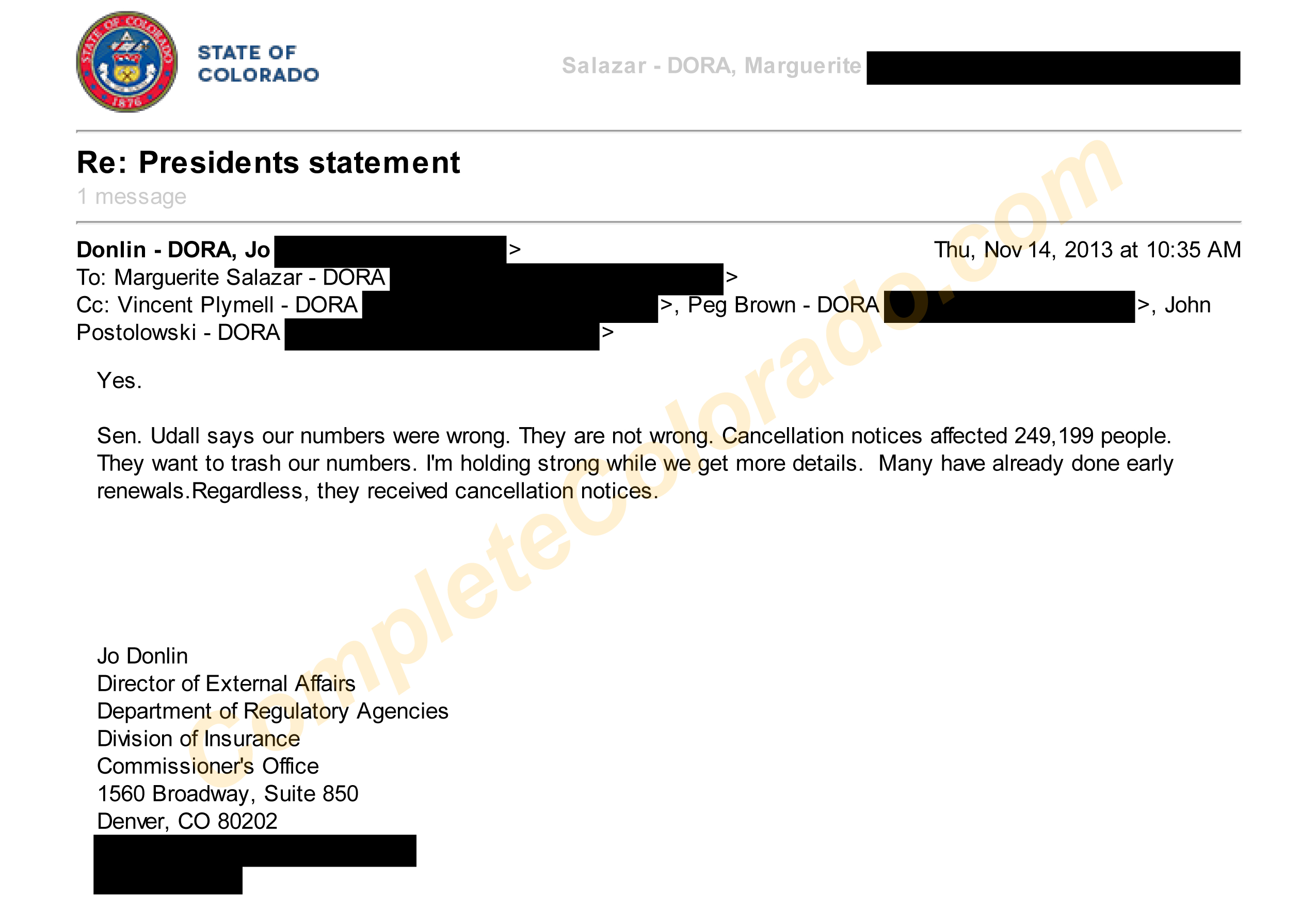
Rather than work to fix Obama's healthcare bill like other Democrats, Senator Mark Udall (D-CO) pressured a state agency to change the way its estimated healthcare cancellations because of Obamacare. Udall wanted the state Department of Insurance to downgrade its estimate of Obamacare-related insurance cancellations from 250,000 to just 73,000, because while the plans they liked were cancelled some Colorado residents were offered replacement plans.
Udall is broad brushing and assuming that because Anthem and Kaiser offered early renewals, the people who received that option after receiving a cellation [sic] notice should not be counted. Commissioner Salazar would like to tell Sen. Udall that 250,000 people were in fact affected by cancellation notices,” insurance department director of external affairs Jo Donlin wrote in November, according the emails.

Emails originally obtained by CompleteColorado.com in January created controversy for the Senator and his vote for President Obama’s Patient Protection and Affordable Care Act. In one of those emails, Donlin said Udall’s office was trying to “trash” the cancellation numbers as tallied by the DOI. In another email, Donlin complained that she received a “very hostile” call from Udall’s deputy chief of staff after she had informed the Senator’s office that the DOI was unlikely to change or modify their calculation of 250,000 policy cancellations in 2013.

Udall’s office did eventually issue their own press release, which netted them a significant story in the Denver Post. In another email, Donlin sent a link of the online Denver Post story to her colleagues, pointing out that the story quoted “Sen. Udall staff,” which seems to highlight that the story did not name an individual directly. Furthermore, Donlin said the online comments were “interesting.” Many of those online comments were critical of both Udall and the Post‘s story. For example, commenter dwschulze said, “So a Democrat who supported Obamacare says that most of the cancelled policies aren’t really cancelled. And you support that with a statement from another Obamacare supporter. You need to provide some independent verification of Udall’s statement for it to be anything but another dubious statement about Obamacare
Can't really blame Senator Udall, like other Democrats who worked to pass Obamacare, he is desperately trying to to put lipstick on the failed pig of the President's signature program.

Tuesday, February 10, 2009

Questions The President Isn't Being Asked--From An Unemployed Blogger

Like many of you, I watched President Obama's "Speech interrupted by by softball questions" that was made to look like a press conference last night. None of the serious questions that should have been asked, were asked.  The President likes to speak of people out of work, well  I lost my job the day after labor day, so maybe he will answer some of these:

1) Mr. President you are rightly concerned about all the people out of work, I appreciate that. Tell me, how many of those people could get a Job if we deported some of the millions of people here illegally?

2)  Speaking of Illegal Aliens why will they be getting $500 per family in your stimulus plan? I am an American Citizen who has paying taxes since I got out of College.  These people broke the law to get here, why are we rewarding breaking the law with a check? In Fact why are we rewarding them with ANY social services.  You cant tell me that they are getting jobs Americans wont take, there are too many of us out of work.

3) Speaking about breaking the law, there is a $5.2 billion dollar housing fund in the bill.  ACORN under investigation for trying to tamper with our most precious institution, Elections.  Would you agree to a provision that ACORN will not be eligible for those Housing Dollars unless they are cleared in all of those cases?

4) You keep saying that you want to pull the US away from foreign Oil. Then why did Interior Secretary Ken Salazar has canceled leases for energy exploration on 77 parcels of federal land in Utah?

5) You say that you are for bi-partisanship.  How come you blame this entire crisis on the Republicans, totally ignoring the role of Democrats such as Barney Frank and Chris Dodd in fighting the regulation of Fannie and Freddie?  How come you don't mention your own involvement when you were an attorney and sued Citibank on the behalf of ACORN, forcing them to make bad loans?

6)  The Stimulus bill has a provision that will track my medical treatments  electronically by a federal system. It also establishes the new bureaucracy, the National Coordinator of Health Information Technology, will monitor treatments to make sure your doctor is doing what the federal government deems appropriate and cost effective. The goal is to  “guide” my doctor’s decisions. This seems a little like 1984. Aren't you turning my medical treatments into a commodity determined by a bureaucracy?

These questions are just a start sir, I would appreciate some honest answers...but I doubt that I will get them.

Wednesday, May 11, 2011

Shale Energy Could Solve America's Energy Problems


In the famous scene from the movie "The Graduate" the character played by Dustin Hoffman is trying to make his way through a party thrown in his honor to celebrate his graduation from college. One of his parent's friends pulls him aside to give him advice for the future, "Ben" he says, "I have one word for you, plastics!"

If the movie was produced today that one word might very well be two words, Shale Energy. Shale gas and could solve this country's energy problems.  And what makes it even more valuable is that there is an ample supply of it in the United States (if our president would let us mine it).

Recent technology breakthroughs have made shale gas extraction cheap, and clean.


It had long been assumed that natural gas could only be extracted when, like oil, it had accumulated in underground reservoirs. But a far greater quantity of gas from organic residues is trapped in the rock itself, and the technology has now been developed to extract it by pumping in water mixed with salt and other chemicals at very high pressure. The advantages are enormous. Not only is it a remarkably cheap source of energy, but since most of the process takes place underground, its “environmental footprint” is minimal – far less than that of oil wells or open-cast coal mines, let alone those useless windfarms.
So miraculous is the potential of shale gas to change the world that several countries, led by the US and China, are already piling in to exploit it on a huge scale. And an admirable introduction to this energy revolution by Matt Ridley has just been published by the Global Warming Policy Foundation, available online under the title The Shale Gas Shock, with a delightful foreword by the world-famous physicist (and “climate sceptic”) Freeman Dyson.
Ridley lucidly explains how and why shale gas is transforming the world’s energy prospects, and reviews the various objections which have been raised to it by environmentalists, to whom it is anathema. They hate it to the point of hysteria because it offers the prospect of a cheap and abundant fossil-fuel that could keep industrial civilisation going for hundreds of years, and is also, according to their prejudices, environmentally friendly, because its CO2 emissions are much less than those of coal or oil.
There are also major supplies of shale gas in Europe and in Israel. Yet in both the EU and United States, environmentalists have the upper hand and are preventing shale oil exploration.

One of the first actions the Obama team took when it assumed office in was to direct Secretary of the Interior Salazar to cancel 77 shale oil and gas leases in Utah. The next year they canceled 61 onshore leases in Montana. TheGreen River shale formation in Utah, Wyoming, and Colorado, has an estimated 800 billion barrels of oil, which is three times the proven reserves of Saudi Arabia. Federal law prohibits drilling for most of these resources. In the Bakken oil shale formation in the Dakotas, there are an estimated 20 billion barrels of oil.


In the Marcellus shale formation in West Virginia, Pennsylvania, and New York, there
could be as much as 500 trillion cubic feet of natural gas, the largest natural gas field in
the world.

Number three in shale energy holdings is  Israel, they have developed technology to make shale oil drilling even cheaper and cleaner,  this will be used for Israel to extract its vast shale oil resources.


The British-based World Energy Council reported in November 2010 that Israel had oil shale from which it is possible to extract the equivalent of 4 billion barrels of oil. Yet these numbers are currently undergoing a major revision internationally.


A new assessment was released late last year by Dr. Yuval Bartov, chief geologist for Israel Energy Initiatives, at the yearly symposium of the prestigious Colorado School of Mines. He presented data that our oil shale reserves are actually the equivalent of 250 billion barrels (that compares with 260 billion barrels in the proven reserves of Saudi Arabia). 
Independent oil industry analysts have been carefully looking at the shale, and have not refuted these findings. As a consequence of these new estimates, we may emerge as the third largest deposit of oil shale, after the US and China.
Israeli scientists have found a way to produce shale energy, and water in the same process.

Yet new technologies, being developed for Israeli shale, seek to separate the oil from the shale rock 300 meters underground; these techniques actually produce water, rather than use it up.

The technology will be tested in a pilot project followed by a demonstration stage. It will be critical to demonstrate that the underground separation of oil from shale is environmentally sound before going to full-scale production. The present goal is to produce commercial quantities of shale oil by the end of the decade.
If the energy industry was allowed to fully exploit our shale reserves, not only would it bring down the price of Energy, create Jobs, help cut the federal deficit, and eliminate our dependence on foreign reserves. 


Bringing down the price of energy and cutting our dependence on foreign reserves will also help the US in the war on terror as some of the money spent on OPEC oil gets transferred to the hand of terrorists in the Arab world.

Exploiting our shale reserves is a win-win for America, but sadly the President and his progressive friends are determined to turn America way from fossil fuels whether it makes sense or not, and that determination is more important to the progressives than the future well-being of the United States.

Enhanced by Zemanta

Monday, February 15, 2010

Dems Beginning to Distance Themselves From Obama, With Obama's Approval

Little by little you can see it happening, one senator here, one congressman there, some of the more "moderate" democrats are starting to distance themselves from Barack Obama.

Ben Nelson's acceptance of a little extra money for his home state in exchange for supporting Obamacare made him very unpopular at home, now the Nebraska Democrat says he may not support the revised bill if it comes back to the senate and he supported a Republican-led filibuster over President Barack Obama's nominee to serve on the National Labor Relations Board, Craig Becker.

Evan Bayh who is not in trouble is making rumblings against his party. Many in his party, Mr. Bayh said, are "tone deaf" about the real message voters are sending, which is that Democrats have "overreached rather than looking for consensus with moderates and independents." He added: "It is amazing that some people here in Congress still don't get it.…For those people it may take a political catastrophe of biblical proportions before they get it. I don't think we'll get to that. But we might.

Even progressive Senator Jay Rockefeller is starting to criticize the President in public. Especially when it comes to the WV state rock, COAL.  "He says it in his speeches, but he doesn't say it in (his budget proposal). He doesn't say it in the actions of (EPA Administrator) Lisa Jackson. And he doesn't say it in the minds of my own people. And he's beginning to not be believable to me,"


According to the LA Times the inching away from the POTUS is being executed with complete approval of the President as he looks to save his Congressional Majority.
 As President Obama's approval ratings sag and the mood of voters sours, some Democratic congressional candidates are distancing themselves from the White House, with the back-channel blessing of party officials.


The candidates are positioning themselves as independent voices no less frustrated with the Obama administration than people back home.


Rep. Dennis Cardoza, a Democrat who represents a California Central Valley district burdened by high unemployment and home foreclosures, said in an interview: "The Obama administration has failed miserably in trying to solve the problem."


Rep. Jim Costa, a Democrat who also represents California's Central Valley, blames Interior Secretary Ken Salazar for not doing enough to alleviate a drought that has hobbled farmers. Costa said his phone calls to White House Chief of Staff Rahm Emanuel have gone unreturned.


"They're not listening carefully enough to the people I represent," Costa said.


Asked whether he wants the president to campaign for him, Costa said: "I'm more popular in my district than the president."


Far from discouraging an independent stance, the White House political operation and the Democratic congressional leadership are tacitly putting out word that the strategy may be a useful one, according to party campaign operatives.


Rep. Chris Van Hollen (D-Md.), who leads the Democratic Congressional Campaign Committee, said in an interview: "Our candidates need to reflect the values and priorities of their districts. And that means on some issues they'll support the Obama administration's position, and on some issues they'll oppose it."


Moving in lock step with the White House poses risks for certain Democrats. Some 49 House Democrats serve in districts that Republican John McCain won in the 2008 presidential election.


In this climate, an array of Democrats are confronting the administration in unusually blunt terms.


Cardoza's district went heavily for Obama, but it has been devastated by the recession. One county he represents, Stanislaus, has the highest foreclosure rate in the state, with 1 out of every 107 homes receiving a foreclosure notice last month. Cardoza has suggested that Housing Secretary Shaun Donovan needs to resign for failing to deliver needed financial assistance.


In a letter to Donovan last month, Cardoza wrote: "If you can't turn your department around then you should do the honorable thing."


Cardoza said in an interview, "The president isn't welcome to campaign with me right now. He is welcome to come to my district and help me do my job, which is providing relief to my constituents."


A moment for embattled party members to showcase their differences with Obama came during his appearance before Senate Democrats this month. Democrats in tough reelection campaigns posed questions that in some cases reflected profound differences with the administration.


Sen. Blanche Lincoln (D-Ark.), who is running for reelection in a state won by McCain, urged Obama to "push back against people in our own party that want extremes." In short order, her campaign website featured a report: "Lincoln challenges Obama on liberal 'extremes.' "


Lincoln's campaign manager, Steve Patterson, said that Obama's limited ground operation in Arkansas in the presidential election suggests that he would not be a huge help.


"If I'm sitting back to think about the best draws to raise money in Arkansas, I don't think it would be President Obama," Patterson said.


Some party veterans cautioned that it is futile for Democrats to create a separate identity from that of the White House. Midterm elections are invariably a referendum on the president's performance, said former Sen. Robert Torricelli of New Jersey, who once chaired the Democrats' Senate election committee.


"Everybody is in one boat," Torricelli said in an interview. "I'd recommend correcting the course of the boat rather than swimming away from it."
Bob Torricelli doesn't understand, this is being done precisely not to change direction of the boat. Like Obama's "moderation" during the 2008 campaign, this is just a cynical attempt to get elected, and then return to their progressive ways. Especially those in the Senate who would not have to face another campaign for six years.